
LED Street Light Manufacturer for Municipal Road Projects
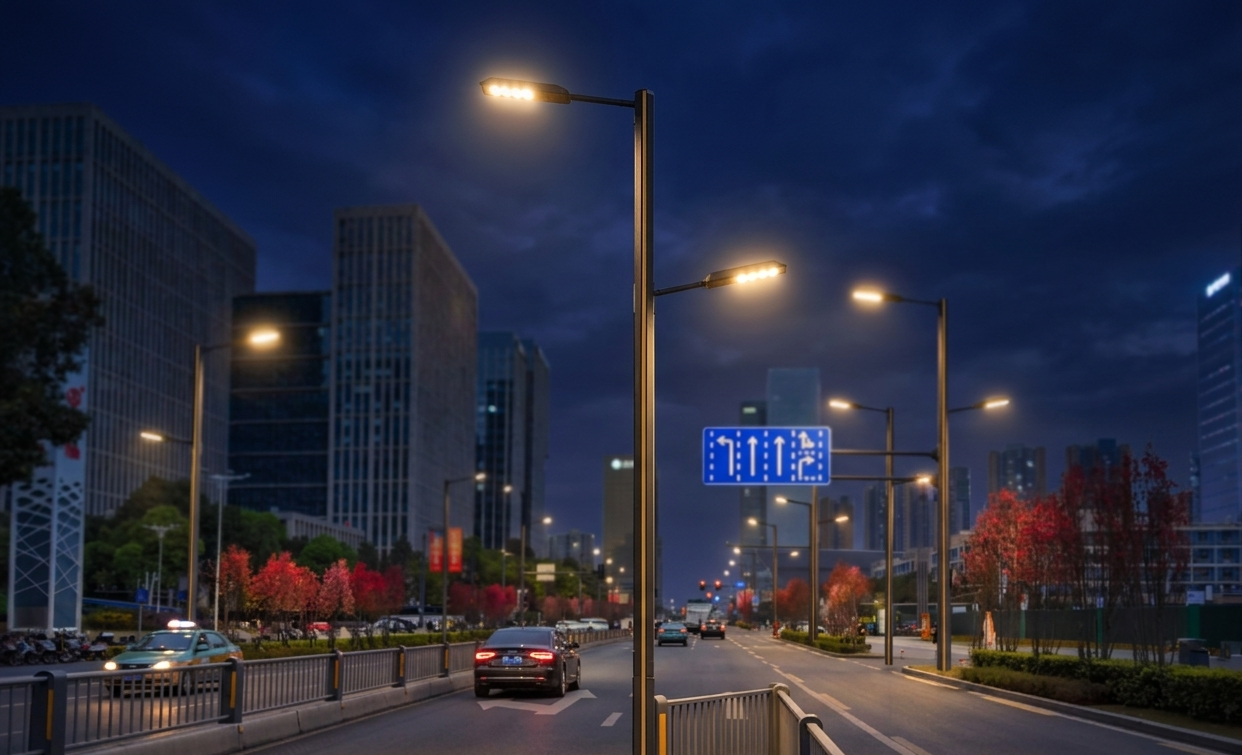
Choosing the right LED Street Light Manufacturer is critical for municipal road projects where durability, efficiency, and long-term performance directly affect public safety and maintenance costs. Lishida Smart Lighting supports contractors and project owners with reliable outdoor lighting products, smart control systems, and integrated project solutions designed to simplify delivery and ensure consistent results in complex urban environments.
In municipal procurement, street lighting is rarely judged only by fixture price. What matters in practice is whether the manufacturer can support a project from specification to commissioning, and whether the installed system can keep performing under real road conditions for years. This is where many projects separate low-cost supply from true project capability.
Municipal road lighting is a system decision, not a single-product purchase
For city roads, highways, arterial streets, and public urban corridors, lighting affects more than visibility. It influences traffic safety, pedestrian comfort, municipal energy use, maintenance planning, and increasingly, smart city infrastructure readiness. As a result, selecting a manufacturer is not simply about lumen output or wattage. It is about whether the supplier understands roadway classification, optical distribution, environmental exposure, control compatibility, and the realities of large-scale delivery.
Many buyers still make the mistake of comparing road lighting suppliers as if they were supplying a standard industrial commodity. Municipal projects are less forgiving. A fixture that performs well on paper may still create field problems if glare control is poor, beam angles do not match road width, surge protection is insufficient, or the housing fails under heat, dust, or humidity. In these cases, the real cost appears later through complaints, rework, and maintenance cycles.
What procurement teams should evaluate beyond price
For municipal road projects, procurement teams typically need to assess five issues at the same time: compliance, lighting performance, reliability, supply capability, and long-term serviceability. The challenge is that these factors often belong to different departments. Engineers focus on photometric performance. Purchasing looks at cost and lead time. Project managers care about delivery coordination. Municipal owners are concerned with lifecycle cost and public accountability.
This is why an LED Street Light Manufacturer with project experience tends to be more valuable than a factory that only offers catalog products. A capable manufacturer should be able to respond to road class requirements, pole spacing constraints, mounting height, local climate, and dimming or smart control requirements. It should also be able to support documentation, testing, and batch consistency across a full project schedule.
In practical terms, buyers should ask:
- Can the supplier provide optical options suitable for different road geometries?
- Is the fixture designed for stable outdoor operation, not just lab-rated performance?
- Can the manufacturer handle phased delivery for large public projects?
- Are dimming and control interfaces compatible with municipal control strategies?
- How will spare parts, maintenance access, and warranty issues be handled after installation?
Why optical design and control compatibility matter more than many expect
In road lighting, efficiency alone is not enough. A high efficacy figure may look attractive, but if the light distribution does not fit the roadway, the project may still fail to meet practical performance goals. Uneven illumination, dark patches, excessive spill light, or poor cutoff can all create operational and compliance issues.
This is why beam selection deserves more attention during specification review. Urban roads, highways, intersections, and mixed traffic zones do not require the same light distribution. A manufacturer that offers multiple optics and can align them with mounting layout usually reduces redesign risk. For example, luminaires with beam angles such as 30°, 60°, 90°, 90*120°, or 80*150° are better positioned for project-based adaptation than one-size-fits-all products.
Control compatibility has also become a more important purchasing criterion. Many municipalities now expect future-ready lighting infrastructure, even if full smart city deployment is not part of the first installation phase. Dimming options such as PWM, PLC, or 0-10V can improve energy management flexibility and support later integration. This does not mean every city needs a complex control system immediately, but it does mean buyers should avoid locking themselves into fixtures with poor upgrade paths.
Durability is where lifecycle cost is really decided
For municipal road projects, durability is not an abstract quality claim. It directly affects maintenance frequency, labor deployment, traffic disruption, and public satisfaction. A fixture installed on a major road is far more expensive to repair than to purchase. Lane closures, access equipment, and scheduling constraints quickly turn a minor failure into a significant operating expense.
That is why procurement teams should look closely at enclosure protection, thermal management, component quality, and expected service life. An IP66 rating, for example, is often relevant for outdoor road environments because it indicates resistance to dust and powerful water exposure, but that number alone should not end the conversation. The broader question is whether the overall design can maintain LED and driver stability across varying temperatures and long operating hours.
Products designed for 50,000 hours or more can support municipal lifecycle planning, but only if the manufacturer has consistent production quality and sound component selection. LED source brands such as CREE or OSRAM are often viewed positively in project environments because they suggest a more controlled component strategy, though buyers should still verify the full system design rather than relying on brand references alone.
The manufacturer’s engineering role is often underestimated
In many overseas sourcing discussions, buyers focus heavily on factory scale and certifications. Those factors matter, but municipal projects also require engineering support that goes beyond manufacturing output. Real project execution often involves adapting to tender specifications, confirming application scenarios, coordinating with pole design and electrical systems, and resolving installation constraints before goods reach site.
This is especially relevant in urban environments where roads, public spaces, and smart infrastructure overlap. Manufacturers with engineering depth can help reduce mismatches between design intent and field installation. That support may include photometric recommendations, control system coordination, or guidance on selecting appropriate wattage ranges for different road segments.
A project-oriented luminaire such as LED Street Light Luminaire reflects the direction many municipal buyers are now taking: broader power coverage, outdoor-grade protection, multiple optics, dimming compatibility, and an application range that includes roads, highways, and smart city scenarios. In this category, specifications such as 50-350W power range, 150 lm/W efficacy, AC176-264V input, and CCT options from 2000K to 6500K are useful not because they look comprehensive in a datasheet, but because they allow adaptation across different project conditions.
Common mistakes when selecting an LED Street Light Manufacturer
One common mistake is treating all outdoor LED suppliers as equivalent if their brochures look similar. In practice, large municipal projects expose differences very quickly. Batch consistency, packaging protection, driver reliability, heat dissipation, and mounting accuracy all become visible at scale.
Another mistake is over-prioritizing peak efficiency while underestimating maintenance access and control integration. An efficient fixture that is difficult to service or incompatible with local dimming strategy can become a poor asset over time.
A third mistake is failing to evaluate delivery coordination. Municipal projects often involve phased construction, revised schedules, and site-specific installation windows. Manufacturers that cannot maintain stable production and communication create risk even if the product itself is acceptable.
There is also a recurring misconception that smart functionality always means higher complexity and unnecessary cost. In reality, what municipalities increasingly need is not full automation everywhere, but sensible readiness. If a lighting system can support gradual upgrades, dimming strategies, and centralized management when required, it improves long-term asset value.
How experienced manufacturers support better project outcomes
Manufacturers with proven large-scale project experience tend to contribute in three practical ways. They reduce uncertainty in specification matching, they improve delivery control, and they support more stable long-term operation. This is particularly important for contractors and project owners working under performance obligations, schedule pressure, and public accountability.
Lishida Smart Lighting’s positioning in this area is notable because it combines manufacturing capability with project-based support, including lighting products, smart control systems, and integrated outdoor solutions. For municipal road projects, that kind of support matters more than a simple supply relationship. It means the manufacturer is prepared to engage with the full delivery process rather than only the shipment stage.
When a supplier understands how road lighting performs in actual urban environments, discussions become more practical. Questions shift from “What is the lowest unit price?” to “What configuration best fits this road class?”, “How will the control system evolve later?”, and “What will maintenance look like after three years?” Those are the questions that usually determine whether a project performs well over its operating life.
What the market is signaling now
The municipal outdoor lighting market continues to move toward higher efficiency, smarter controls, and more accountable lifecycle performance. Energy savings still matter, but cities are increasingly focused on operational resilience and system intelligence. That means the role of an LED Street Light Manufacturer is expanding. The market no longer expects only a fixture producer. It increasingly expects a technically capable project partner.
For buyers, contractors, and decision-makers, the implication is clear: the best manufacturer for municipal road projects is not necessarily the one with the cheapest fixture or the widest catalog. It is the one that can consistently align product design, engineering support, project delivery, and long-term reliability with the realities of public infrastructure.
That is the standard municipal procurement is moving toward, and it is the standard manufacturers must now meet if they want to remain relevant in serious road lighting projects.
◉ MESSAGE
Blog
- LED Street Luminaire Specifications That Matter for Roadway Projects
- What to Evaluate When Selecting a Smart Street Lamp Manufacturer
- How to Prepare a Compliant Solar Lighting Bid for Public Infrastructure Projects
- LED Street Lighting Solutions for Urban and Municipal Roads
- LED Street Light Installation Guide for Road Projects
- LED Street Light Lifespan: How Long Do LED Road Lights Last?
- LED Street Light IP Rating: What Should Buyers Choose?
Message