
LED Street Light IP Rating: What Should Buyers Choose?
LED Street Light IP Rating: What Should Buyers Choose?
When evaluating LED street light IP rating options for roads, public spaces, and urban projects, buyers need more than a basic waterproof standard. The right choice affects long-term reliability, maintenance costs, and overall project performance. For contractors and project owners, understanding how IP rating relates to real outdoor conditions is essential to selecting lighting systems that deliver durable, efficient, and dependable results.
In practice, the question is rarely “Is this luminaire waterproof enough?” It is usually “Will this fitting still work after years of dust, rain, heat, road spray, and maintenance access issues?” That is a different conversation. In outdoor lighting, especially on municipal roads or large public projects, an IP rating is a useful filter, but not the whole answer.
What IP rating actually tells you
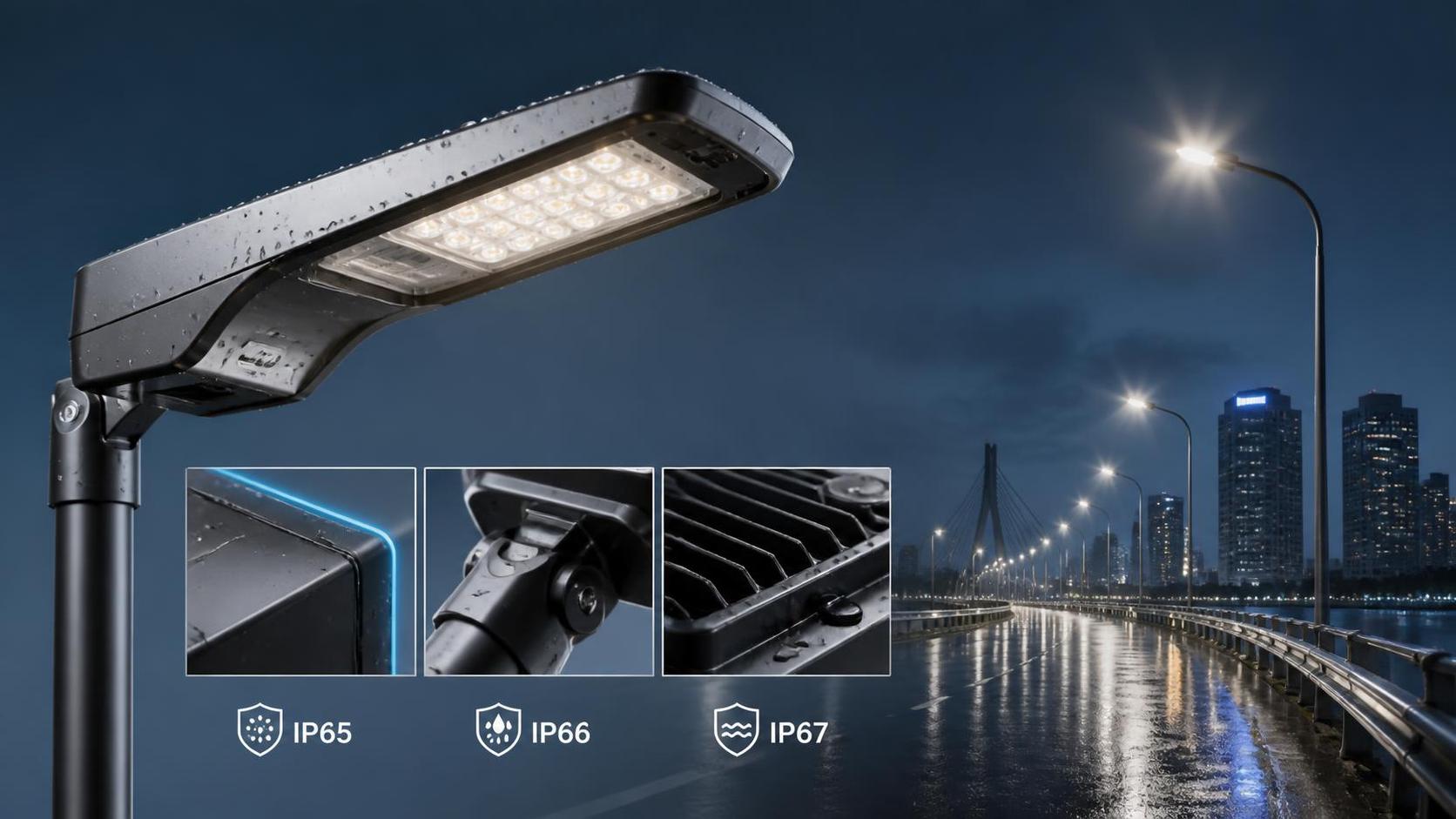
IP stands for Ingress Protection. The first digit refers to protection against solid particles such as dust, and the second refers to water. For street lighting, buyers often compare IP65, IP66, and IP67.
A simple way to read it:
That said, a higher number does not automatically mean a better project choice in every situation. Street lights are not underwater fixtures. They spend most of their life exposed to weather, airborne dust, temperature swings, and sometimes poor installation conditions. So the right decision depends on where the light will be installed and how the whole fixture is designed.
Why many road projects move beyond IP65
IP65 is still seen in outdoor lighting, and for some mild environments it may be acceptable. But on real road projects, buyers often become more cautious. Open roads, intersections, bridges, coastal zones, and urban corridors are exposed to wind-driven rain, fine dust, exhaust residue, and frequent cleaning. In these settings, the difference between “water jets” and “more robust sealing” starts to matter over time.
This is one reason many contractors now treat IP66 as a practical baseline and look to IP67 when conditions are harsher or maintenance access is difficult. If a luminaire is installed at 10 or 12 meters, replacing failed units is not a small job. Traffic control, lifting equipment, labor scheduling, and public complaints all add cost well beyond the fixture price.
From a project delivery perspective, reliability is often worth more than shaving a small amount off the initial procurement cost.
Where IP67 makes sense for street lighting
IP67 is not mandatory for every road, but it is a sensible choice in several common scenarios:
- Coastal roads or ports, where moisture and salt exposure are persistent
- Tunnels, underpasses, and low-lying areas with heavy condensation or splash risk
- Urban infrastructure with intensive washing or high-pressure cleaning
- Projects where maintenance interruptions are expensive or difficult to organize
- Dust-heavy environments near construction corridors, industrial roads, or logistics zones
It also helps when a project owner wants more confidence in long-term sealing performance, not just day-one compliance. That is where fixture quality, gasket design, housing integrity, cable entry, and driver compartment sealing become just as important as the printed IP mark.
A common buying mistake: choosing by IP rating alone
An IP rating should never be read in isolation. Two luminaires may both claim IP67, yet perform differently in service life. Why? Because the rating is a test result under specific conditions, while field performance depends on manufacturing consistency and system design.
For example, if the housing material corrodes easily, if the powder coating is weak, if the cable gland is poorly assembled, or if heat management is compromised, the fixture can still fail early even with a strong ingress rating. Outdoor lighting buyers who have worked on large projects usually learn this the hard way: sealing is one layer of reliability, not the whole structure.
That is why experienced suppliers tend to discuss the full application context. At Lishida Smart Lighting, road and public-space projects are usually evaluated not only by luminaire protection level, but also by installation environment, structural durability, smart control compatibility, and the realities of long-term operation. In large-scale urban work, product selection is closely tied to execution risk.
What else buyers should check before approving a fixture
If the target is durable street lighting rather than a short-term replacement, these points deserve attention alongside the IP rating:
- Housing material and corrosion protection
- Heat dissipation design for the LED and driver
- Wind resistance, especially for higher poles and open-road exposure
- Ease of maintenance and spare part access
- Driver quality and electrical protection details
- Optical performance, not just sealing performance
A useful example is Modern Street Lighting|MSL-HCH, which combines an IP67 protection level with practical outdoor parameters such as 8–14 m pole height, 4–8 mm pole thickness, hot-dip galvanized plus powder-coated surface treatment, and wind resistance of at least 150 km/h. Those details matter because road lighting reliability is built from the entire assembly: pole, luminaire, finish, LED components, and installation interface.
The same applies to performance targets. A fixture with luminous efficacy of at least 140 lm/W and LED lifespan around 50,000 hours may support lower energy use and longer service intervals, but only if the project’s thermal and electrical design is sound. On paper, high efficacy looks good. On the road, consistency is what counts.
So what should buyers choose?
For most standard street lighting projects, IP66 is often a reasonable minimum to compare against. It suits many road and public-space applications where exposure is real but not extreme. If the project is in a demanding environment, or if the owner is trying to reduce long-term maintenance risk, IP67 is usually the safer direction.
Still, the best buying decision is not “pick the highest number available.” It is “pick the protection level that matches the site, then verify the rest of the fixture is built to the same standard.” That includes structural life, corrosion resistance, optical quality, and compatibility with the broader lighting system. For integrated urban projects, especially those involving controls and large installation volumes, those details affect delivery just as much as the fixture specification sheet.
If a supplier cannot explain how the IP rating fits the actual operating environment, that is usually a warning sign. Buyers should ask not only how the product is tested, but how it is expected to age in the field. That is often where the better procurement decision becomes clear.
◉ MESSAGE
Blog
- LED Street Luminaire Specifications That Matter for Roadway Projects
- What to Evaluate When Selecting a Smart Street Lamp Manufacturer
- How to Prepare a Compliant Solar Lighting Bid for Public Infrastructure Projects
- LED Street Lighting Solutions for Urban and Municipal Roads
- LED Street Light Installation Guide for Road Projects
- LED Street Light Lifespan: How Long Do LED Road Lights Last?
- LED Street Light IP Rating: What Should Buyers Choose?
Message