
How to Choose a Reliable LED Street Light Manufacturer
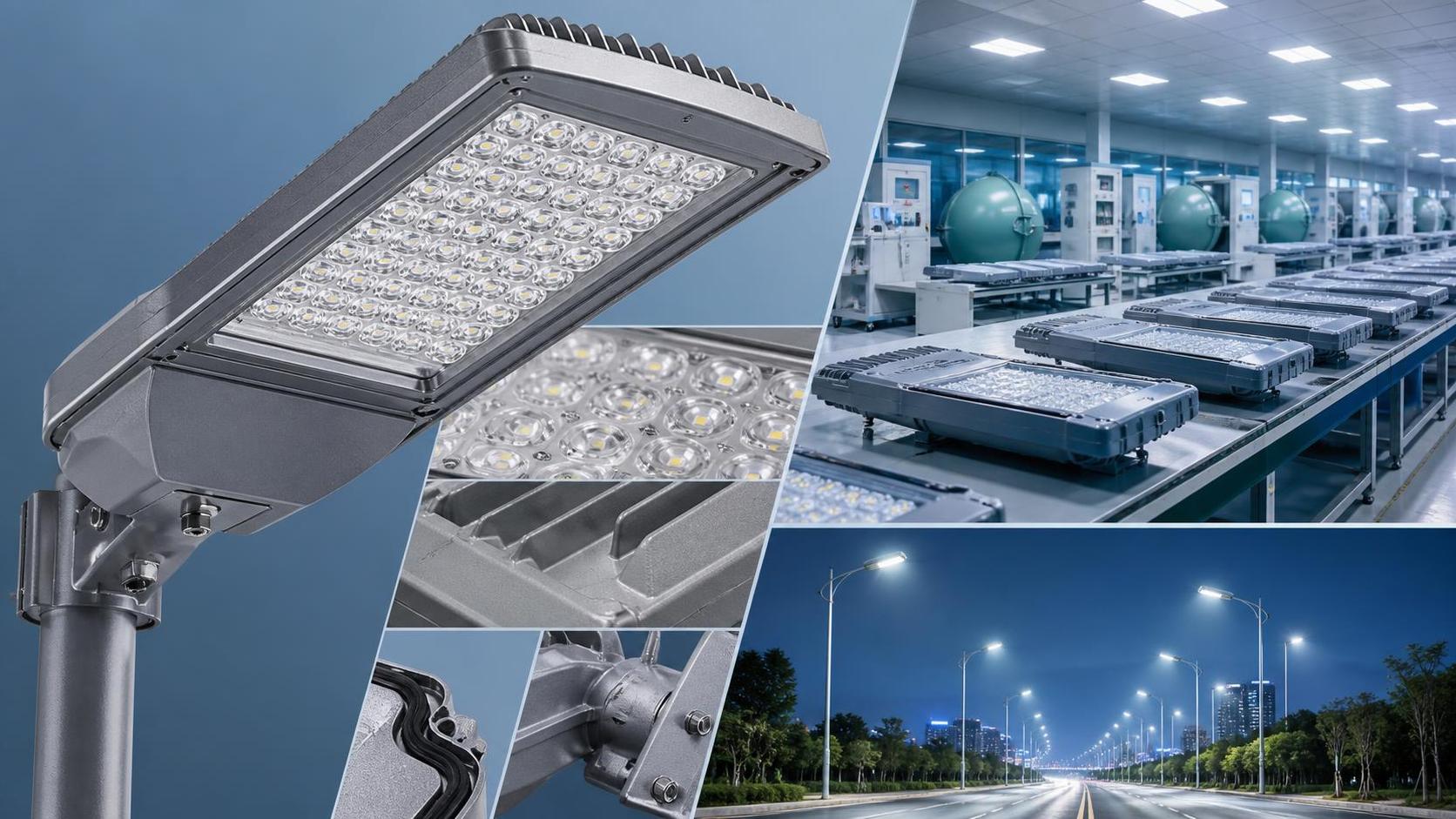
Reliable street lighting starts with a manufacturer that can hold performance steady long after installation. A fixture may look acceptable on a datasheet, yet still create trouble later through uneven heat dissipation, weak driver protection, poor optical control, or inconsistent assembly. The right choice usually becomes clear when technical details, factory discipline, and project coordination all line up instead of relying on appearance or a low unit price.
One of the first things to examine is whether the product design fits real outdoor conditions. LED street lights operate under dust, moisture, vibration, temperature swings, and long nightly running hours. A reliable manufacturer should be able to explain the housing material, corrosion resistance, sealing method, lens material, and thermal path from LED chips to the heat sink. Die-cast aluminum is common, but the important point is how well the structure moves heat away from the light source and driver. If thermal management is weak, lumen depreciation may accelerate, color stability can drift, and driver life may shorten well before the project expects replacement.
Look Beyond the Basic Datasheet
Many quotations list wattage, luminous efficacy, color temperature, and IP rating, but those figures alone do not tell enough. Ask how the optical system is configured for different road classes, mounting heights, and pole spacing. A dependable manufacturer should be able to discuss lens distribution rather than offering one beam pattern for every roadway. Poor light distribution can force higher wattage to compensate for dark areas, which increases energy use without solving uniformity.
Driver selection deserves the same scrutiny. In street lighting, the driver often determines survival under unstable grid conditions, surge events, and long operating hours. It is worth confirming input voltage range, surge protection level, dimming compatibility, and whether the driver compartment allows practical replacement if maintenance is needed later. Some products look sealed and compact but become expensive to service because the internal layout was never designed for field access.
Consistency in LED binning and optical components also matters. A manufacturer that cannot keep stable color temperature and output across batches may create visible differences from one road section to another. That problem often appears only after phased delivery, when fixtures from different production runs are installed on the same route.
Manufacturing Capability Is a Practical Issue, Not a Marketing Phrase
Reliability is tied to repeatability. A factory may produce a good sample, yet still fail on mass production if assembly control is loose. Ask about the production flow: incoming material inspection, die-casting quality control, PCB mounting, waterproof testing, aging, and final inspection. Even a simple question such as how each batch is traceable can reveal whether the manufacturer runs a disciplined process or only assembles to order.
Pay attention to mechanical details that affect long-term use. Fasteners, gasket quality, cable glands, coating thickness, and bracket strength are easy to overlook during quotation review. These parts become serious issues once fixtures face wind load, heavy rain, or repeated maintenance access. If a bracket slips after installation or a gasket loses elasticity, the project may face water ingress or beam angle deviation without any fault in the LED chips themselves.
Sampling should also be handled carefully. A single showroom sample is not enough when the project scale is large. It is more useful to review production-level samples with the same driver, LED package, lens, finish, and mounting hardware intended for delivery. Otherwise, the approved sample may not represent the shipped product.
Evaluate Communication Through Technical Response Quality
A reliable manufacturer usually answers technical questions with clear limits and conditions rather than broad promises. If asked about lifetime, operating temperature, or smart control compatibility, the response should include assumptions such as ambient temperature, dimming profile, installation environment, and maintenance access. Vague assurances often indicate that engineering review happens too late, after procurement or installation has already moved forward.
This becomes more important when a project includes dimming schedules, remote monitoring, or mixed lighting zones. Street lights are no longer isolated fixtures in many urban applications. They may need to work with control nodes, central management systems, or segmented operating strategies. A manufacturer should be able to explain how the luminaire, driver, and control interface are integrated, and what changes if the control architecture is adjusted during the project.
That same engineering depth often appears in adjacent outdoor lighting categories. For example, landmark or facade zones near road networks sometimes require a narrow-beam projector instead of a street light. In that context, a model such as LED Beam Projector may be specified when long-range, high-brightness output, DMX512 control, IP65 protection, and adjustable 2-30° beam control are needed. The point is not the product itself, but whether the manufacturer can manage different optical and control requirements without turning integration into guesswork.
Delivery Risk Often Starts Before Production
Street lighting projects are frequently delayed by mismatched specifications, incomplete pole interface details, or unclear cable entry requirements. A dependable manufacturer should confirm installation conditions early: pole diameter, arm length, tilt angle, access door space, local voltage conditions, grounding method, and any need for pre-wired connectors or control receptacles. If these details are treated casually, the product may arrive on site technically functional but awkward to install.
Packing and transport are another overlooked area. Outdoor luminaires with large cast housings, tempered glass, or external brackets can suffer damage if cartons and pallet methods are weak. It helps to confirm how fixtures are packed, whether mounting accessories are separated or preassembled, and how the packaging reduces finish abrasion or lens impact during loading and unloading. Cosmetic damage is not always superficial; a deformed housing can compromise sealing performance.
Warning Signs That Often Lead to Problems Later
- A quotation changes key components without clearly recording the revision, especially the driver, LED source, or lens.
- Photometric files are unavailable, outdated, or do not match the offered model.
- Only headline values are discussed, while housing structure, ambient limits, and maintenance access stay undefined.
- Lead time sounds unusually short, but no one explains stock status, production capacity, or test steps.
- Technical questions are answered by repeating brochure language rather than addressing the exact installation condition.
Another common mistake is treating all IP65 or IP66 products as equal. In practice, sealing reliability depends on the enclosure design, machining accuracy, gasket compression, and cable entry treatment. Two fixtures may carry the same ingress rating on paper yet behave very differently after repeated thermal expansion and contraction outdoors.
Use Trial Evaluation to Expose Hidden Weaknesses
If project timing allows, request a structured sample review rather than a simple visual inspection. Observe startup behavior, dimming response, housing temperature during operation, bracket adjustment, cable routing, and enclosure opening for maintenance. If controls are involved, test addressing, communication stability, and failure recovery after power interruption. These steps often reveal more than a polished presentation ever will.
It is also useful to compare documentation quality. Installation manuals, wiring diagrams, parts lists, and labeling may seem secondary, but they affect site efficiency and reduce avoidable mistakes. A manufacturer with poor document control may create confusion during installation, commissioning, or later replacement, even if the luminaire itself is acceptable.
Choosing a reliable LED street light manufacturer usually comes down to one practical question: can the same supplier maintain product consistency, answer technical constraints directly, and deliver fixtures that are straightforward to install and maintain under real outdoor conditions? When the answer is visible in both the product details and the working process, the project risk becomes easier to manage.
◉ MESSAGE
Blog
- LED Street Luminaire Specifications That Matter for Roadway Projects
- What to Evaluate When Selecting a Smart Street Lamp Manufacturer
- How to Prepare a Compliant Solar Lighting Bid for Public Infrastructure Projects
- LED Street Lighting Solutions for Urban and Municipal Roads
- LED Street Light Installation Guide for Road Projects
- LED Street Light Lifespan: How Long Do LED Road Lights Last?
- LED Street Light IP Rating: What Should Buyers Choose?
Message