
How to Choose High Power LED Floodlight Wattage for Large Outdoor Areas
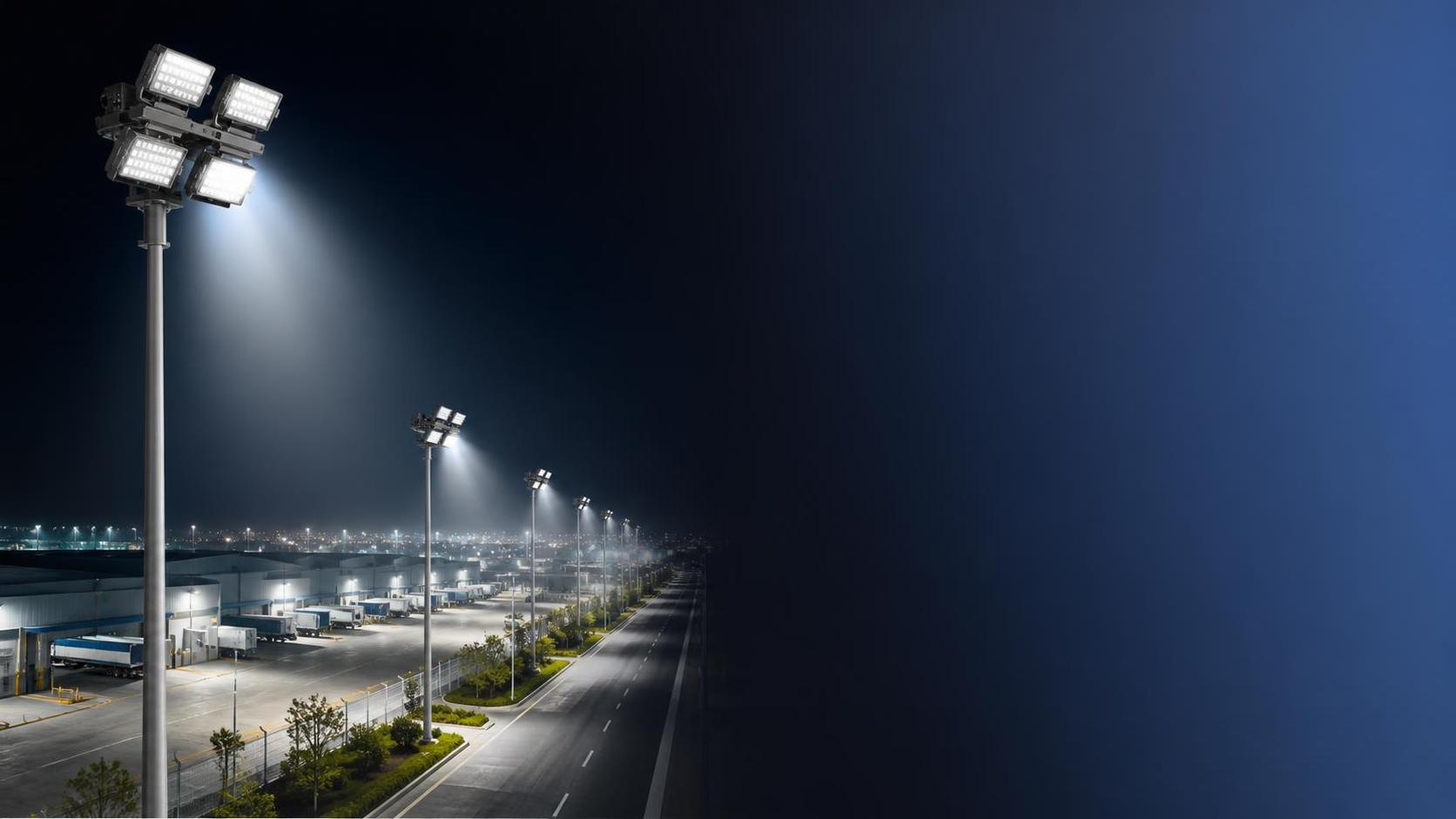
How to Choose High Power LED Floodlight Wattage for Large Outdoor Areas
Choosing the right high power LED floodlight wattage for a large outdoor area is rarely a matter of “more watts equals better lighting.” In practice, technical evaluation usually starts with a different question: what light level is actually needed on the ground, across the full site, under real operating conditions? Roads, logistics yards, plazas, sports-adjacent spaces, and urban public zones all demand different answers.
A floodlight that looks powerful on paper can still underperform if the beam is too narrow, the pole is too high, glare is uncontrolled, or the control system does not match the project strategy. That is why wattage should be treated as one selection result within a wider lighting design process, not as the starting point by itself.
Start with the lighting target, not the fixture label
For large outdoor areas, the real selection logic usually begins with required illuminance, uniformity, and visual comfort. A traffic node may prioritize visibility and contrast. A public square may need balanced horizontal light with controlled spill. An industrial perimeter may focus on security coverage and reduced maintenance access.
This matters because two high power LED floodlight options with the same wattage can produce very different site results. Optical design, luminous efficacy, color temperature, and aiming angle all affect usable light. If one luminaire delivers higher efficacy and better beam control, it may meet the project target at a lower wattage than a less efficient alternative.
In evaluation work, it is often more useful to ask for a lighting simulation or layout proposal than to compare wattage ranges in isolation.
Mounting height changes everything
The same fixture behaves very differently at 8 meters, 15 meters, or 25 meters. As mounting height increases, light spreads over a larger area, but intensity at ground level drops unless the optical system and wattage are adjusted. This is one of the most common reasons for underlighting in large-area projects.
For example, a moderately powered floodlight may be enough for a lower-mounted façade or compact service yard, yet become inadequate for a wide transport zone when installed on taller poles. On the other hand, simply increasing wattage without reviewing beam angle can create bright hotspots and dark gaps between poles.
Technical reviewers should assess wattage together with pole spacing, mounting height, tilt angle, and beam distribution. If one of those variables changes during the project, the wattage decision may need to change with it.
Beam distribution often matters more than expected
A common mistake in large outdoor lighting is treating floodlights as generic high-output tools. They are not. Narrow, medium, and wide beam optics serve different purposes, and the wrong choice can waste a surprising amount of light.
If the area is long and linear, a broad symmetric flood pattern may not be the best fit. If the site has irregular boundaries, excessive spill light may create complaints or fail local requirements. In urban environments, glare control becomes especially important near roads, pedestrian zones, and mixed-use developments.
This is where experienced project support makes a difference. Lishida Smart Lighting works with contractors and project owners on large-scale outdoor applications, where product selection has to align with control strategy, installation constraints, and long-term reliability rather than just initial brightness.
Do not ignore control compatibility when selecting wattage
In many current projects, the floodlight is no longer a standalone device. Dimming schedules, remote monitoring, fault alerts, and adaptive lighting are increasingly part of the specification. That changes how wattage should be judged.
A slightly higher-rated fixture may still make sense if it will be dimmed intelligently during off-peak hours and maintain better uniformity at full output when needed. Conversely, an apparently efficient low-wattage scheme can become risky if it leaves no margin for future changes in site use, safety requirements, or ambient conditions.
Projects that combine floodlighting with smart street or public-space infrastructure often benefit from reviewing the wider system architecture early. In that context, solutions such as Smart Street Lighting | SSL-CH show how lighting hardware, connectivity, and remote control can be considered together rather than as separate procurement items. Its available communication options, including 4G, 5G, NB-IoT, PLC, and LoRa, are relevant when the outdoor lighting plan extends beyond basic switching.
Use maintenance reality as a selection filter
Large outdoor areas are expensive to relight, inspect, and service. That is why wattage selection should never be separated from durability and operating environment. A technically suitable floodlight still has to survive heat, wind, rain, dust, and long operating cycles.
If the site is exposed, ingress protection, thermal management, and service life deserve close attention. In adjacent smart-pole or roadway systems, evaluators may also compare supporting infrastructure. For example, stainless steel smart pole configurations with IP67 protection, operating temperature ranges from -40℃ to +70℃, wind resistance of at least 150km/h, and service life expectations above 50,000 hours can reduce risk in harsh installations. Those numbers do not directly define floodlight wattage, but they do shape whether the chosen lighting scheme remains reliable after handover.
A practical way to narrow the wattage range
When the specification is still open, it helps to work through the decision in this order:
- Confirm the application target: roadway edge, open plaza, yard, façade, security perimeter, or multi-use urban space.
- Define required light performance based on project standards or local requirements.
- Review mounting height, pole layout, and available installation positions.
- Compare optical distributions before comparing wattage.
- Check efficacy, not just nominal power draw.
- Consider dimming, remote control, and monitoring needs from the start.
- Evaluate maintenance access, environmental stress, and long-term replacement implications.
This sequence usually leads to better decisions than asking suppliers for the “recommended wattage” without a layout context. In real projects, the right answer is often a combination of fixture power, optics, spacing, and controls.
Where technical evaluations often go wrong
The biggest selection errors are usually not dramatic. They are small assumptions that compound later: assuming the brightest fixture is safest, assuming all 200W or 300W products perform similarly, assuming maintenance teams can easily access high-mounted equipment, or assuming control integration can be added later without design changes.
Another issue is copying wattage from a previous project with a different pole height, surface reflectance, or site geometry. Outdoor lighting is sensitive to context. What worked in one municipal road package may be inefficient in a transport hub or public square.
That is why experienced engineering support matters. Teams involved in large-scale projects across roads, public spaces, and urban environments tend to spot integration issues earlier, especially where lighting products, smart controls, and delivery timelines affect one another.
The better question is: what wattage works for this layout?
For large outdoor areas, there is no universally correct wattage for a high power LED floodlight. The technically sound choice depends on how much light the space needs, how that light is distributed, how high the fixture is mounted, and how the system will be operated over time.
If you are reviewing options for a new project or retrofit, ask for the lighting calculation, the optical logic, the control approach, and the environmental assumptions behind the proposal. That will tell you far more than wattage alone. And if the project involves broader smart outdoor infrastructure, solutions related to Smart Street Lighting | SSL-CH may be worth evaluating alongside the floodlighting plan so that lighting, controls, and field conditions are aligned from the beginning.
◉ MESSAGE
Blog
- LED Street Luminaire Specifications That Matter for Roadway Projects
- What to Evaluate When Selecting a Smart Street Lamp Manufacturer
- How to Prepare a Compliant Solar Lighting Bid for Public Infrastructure Projects
- LED Street Lighting Solutions for Urban and Municipal Roads
- LED Street Light Installation Guide for Road Projects
- LED Street Light Lifespan: How Long Do LED Road Lights Last?
- LED Street Light IP Rating: What Should Buyers Choose?
Message