
How a smart lighting control system reduces wasted energy at night
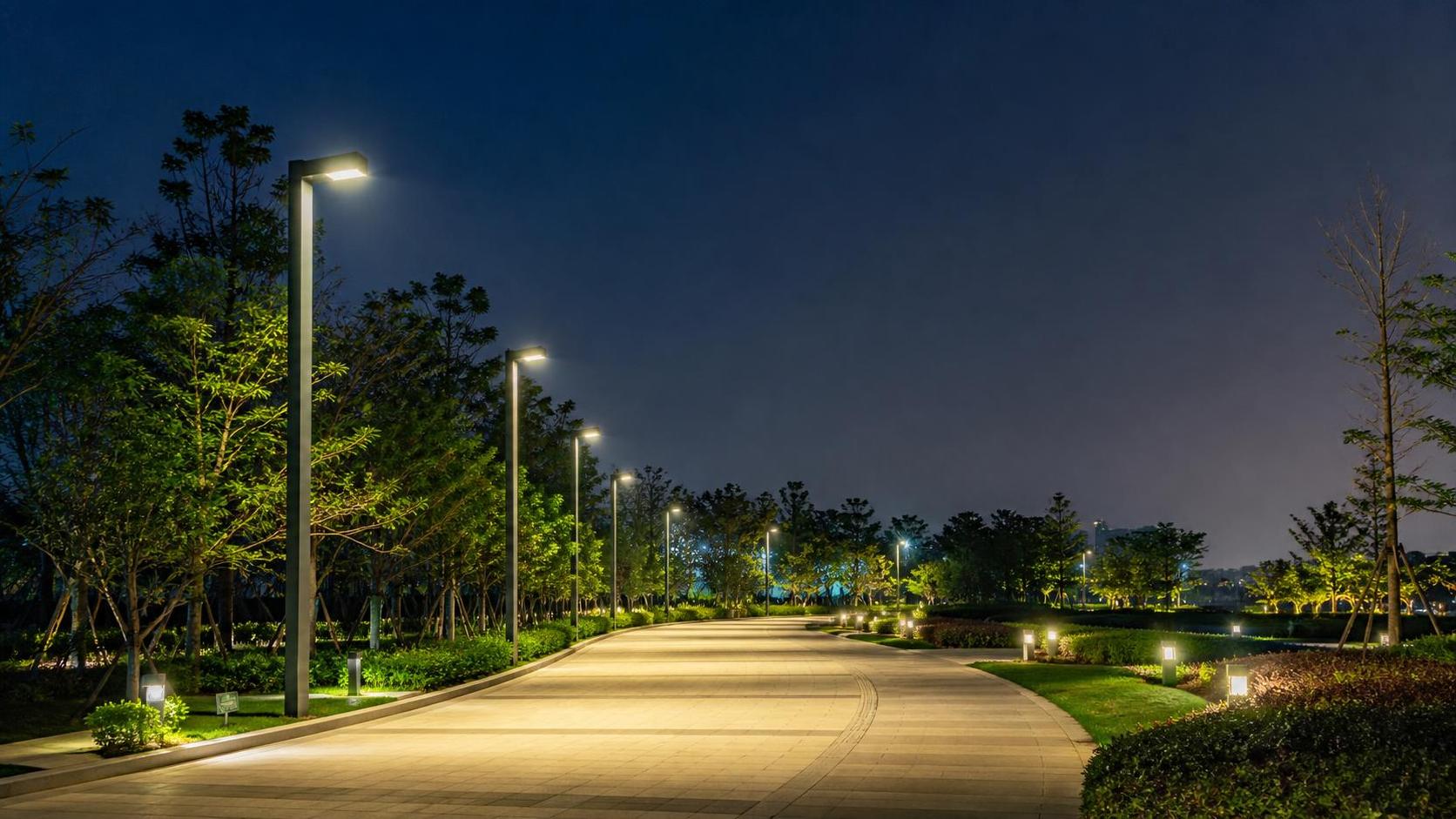
How a smart lighting control system reduces wasted energy at night
For large outdoor lighting projects, wasted energy rarely comes from one dramatic mistake. More often, it comes from hundreds or thousands of luminaires operating at full output when the site no longer needs that level of light. Roads stay bright long after traffic drops. Parks and plazas remain uniformly illuminated through low-activity hours. Peripheral landscape areas are treated the same as main access routes. Over time, those extra operating hours and unnecessary brightness levels turn into avoidable cost, more maintenance pressure, and a less flexible system overall.
A smart lighting control system addresses that problem in a practical way. Instead of treating nighttime as one fixed condition, it allows the lighting network to respond to schedules, occupancy patterns, traffic levels, ambient light, and operating priorities. For contractors and project owners, that matters because energy reduction is only one part of the decision. The system also needs to be reliable in the field, manageable across a large site, and realistic to integrate during project delivery.
Why outdoor projects waste energy after dark
In many projects, the original lighting design is based on peak conditions. That is reasonable at the planning stage: a road must support safe traffic, a public square must remain usable, and a commercial landscape must meet appearance requirements. The problem begins when that peak-state logic continues unchanged all night.
The most common sources of waste are straightforward:
- Lights switch on and off by simple time schedules that do not reflect seasonal change or actual site use.
- Entire zones operate at the same brightness even when some areas have very different traffic or security needs.
- Dimming is technically possible at fixture level but not implemented at system level.
- Faults go unnoticed, so operators compensate by keeping nearby areas brighter than necessary.
- Landscape and pedestrian lighting is specified for visual quality, then run at full output through the quietest hours.
This is why a smart lighting control system is usually more effective than simply choosing lower-wattage fixtures. Efficient hardware helps, but control logic is what prevents good equipment from being used inefficiently.
How smart control reduces nighttime waste in real operating conditions
The main advantage is not “automation” in the abstract. It is selective response.
A well-designed system can dim lighting by time period, by zone, or by trigger. Main traffic corridors may hold a higher baseline, while secondary pathways, gardens, and edge spaces step down later in the evening. If sensors or central control indicate activity, brightness can rise again where needed rather than across the whole site.
That zoning approach is especially useful in public spaces and mixed urban environments, where “night” is not one uniform condition. A transit-adjacent plaza, a municipal park, a commercial landscape, and a service road may all sit within one project boundary, but they should not be controlled the same way.
Another often overlooked benefit is better operational visibility. Centralized control makes it easier to see which luminaires are online, which schedules are active, and where abnormal energy use may be happening. For project owners managing large asset bases, that can be just as valuable as the direct reduction in electricity consumption.
The control system only works if the fixtures support the strategy
This is where some projects run into trouble. Decision-makers sometimes evaluate control software and lighting hardware separately, then discover late in the process that integration is weak, dimming performance is unstable, or the fixtures are not suitable for the site environment.
For outdoor applications, energy savings at night depend on more than the control platform. Fixtures still need consistent efficacy, weather resistance, electrical compatibility, and stable long-term operation. In garden, park, and commercial landscape zones, that can mean balancing visual comfort with durability. A product such as LED Garden&Lawn Lighting | GLL-LGYC fits this kind of discussion because the core parameters are aligned with real site demands: 140 lm/W luminous efficacy, IP67 protection, operating temperature from -40℃ to +70℃, and wind resistance of at least 150 km/h. On paper, those numbers do not “save energy” by themselves, but they support a control strategy that depends on stable performance across changing night conditions.
That same point applies to electrical and structural details. Input voltage tolerance, pole thickness, base flange design, and service life are not side notes in a large project. If maintenance access is difficult or the environment is harsh, a technically advanced control system can still become an operational burden when the fixture platform underneath it is not robust enough.
What decision-makers should verify before choosing a solution
The right question is not simply whether a smart lighting control system can reduce wasted energy at night. In most cases, it can. The more useful question is whether the proposed system can do so without creating new delivery or maintenance problems.
- Control granularity: Can the project manage individual luminaires, groups, or multiple scenes by area?
- Dimming compatibility: Are the fixtures and drivers designed to respond smoothly at lower output levels?
- Communication stability: In dense urban environments, signal architecture and interference risk should be reviewed early.
- Fallback logic: If communication is interrupted, what operating mode will the lights default to?
- Maintenance visibility: Can the operator identify faults and energy anomalies without manual nighttime inspection?
- Project integration: Will the control system align with the selected poles, luminaires, electrical layout, and construction schedule?
These checks are particularly important for large public projects, where savings expectations are high but operating responsibility continues for years. A technically impressive proposal may still be the wrong choice if commissioning is too complex or the maintenance team cannot realistically support it.
Why integrated delivery matters more than isolated components
In practice, nighttime energy reduction is not only a product decision. It is a delivery decision. The lighting products, the control system, the site conditions, and the execution plan all affect whether the intended savings show up in operation.
This is where experienced project support becomes useful. Lishida Smart Lighting works with contractors and project owners on large-scale outdoor lighting projects, from roads and public spaces to more complex urban environments. That kind of support matters because the difficult part is often not selecting a “smart” component, but coordinating product selection, system integration, and long-term reliability in one buildable solution. Manufacturing capability and engineering involvement can reduce friction during delivery, especially when the project includes different lighting layers with different control needs.
In landscaped areas, for example, the control approach may need to preserve visual comfort while still trimming output during low-use hours. A fixture range like LED Garden&Lawn Lighting | GLL-LGYC, with 3000K/4000K main light options, auxiliary 6500K lighting, CREE/OSRAM chip options, 30–60 W main power, and a stainless steel 201 structure for gardens, parks, and commercial landscapes, can make sense when the project requires both appearance and operational resilience. But whether it is the right fit still depends on the control scheme, site layout, and local requirements.
A smart lighting control system reduces wasted energy at night by matching light output to actual need instead of assuming every hour requires the same response. That sounds simple, but in outdoor projects it only works well when control logic, fixture performance, and execution planning are aligned. If you are evaluating a system for a new build or an upgrade, it is worth confirming the dimming strategy, communication method, maintenance model, and fixture compatibility before finalizing the specification. Those details usually determine whether the project delivers measurable operational improvement or just adds another layer of complexity.
◉ MESSAGE
Blog
- LED Street Luminaire Specifications That Matter for Roadway Projects
- What to Evaluate When Selecting a Smart Street Lamp Manufacturer
- How to Prepare a Compliant Solar Lighting Bid for Public Infrastructure Projects
- LED Street Lighting Solutions for Urban and Municipal Roads
- LED Street Light Installation Guide for Road Projects
- LED Street Light Lifespan: How Long Do LED Road Lights Last?
- LED Street Light IP Rating: What Should Buyers Choose?
Message