
Battery Capacity, Solar Panel Size, and Backup Days in Solar Street Lighting SL-008
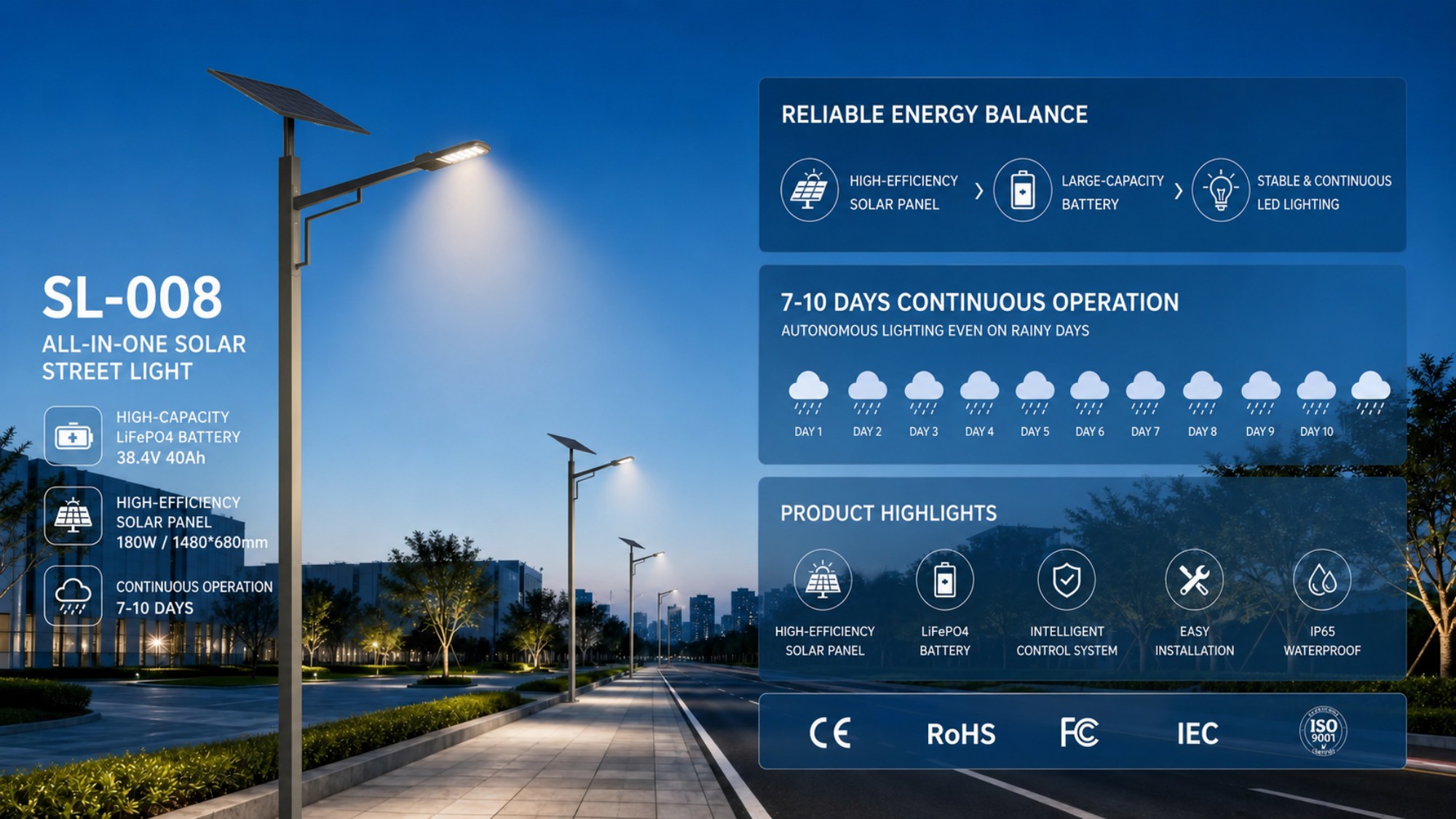
Battery capacity, solar panel size, and backup days shape the real performance of Solar Street Lighting | SL-008 far more than headline wattage alone. In outdoor lighting projects, these three factors determine whether a system can keep roads, pathways, and public areas safely illuminated through changing weather, seasonal solar variation, and long operating cycles.
That is why Solar Street Lighting | SL-008 often needs to be evaluated as an energy balance system, not just a fixture. For large-scale deployments, the key question is simple: can the unit collect enough energy, store it efficiently, and sustain lighting output for the required number of nights without creating maintenance pressure later?
In practice, this matters across roads, public spaces, and more complex urban environments. Project delivery teams increasingly look beyond initial configuration and focus on long-term reliability, system integration, and predictable field performance under real site conditions.
Why these three parameters matter together
Battery capacity defines how much energy Solar Street Lighting | SL-008 can store for nighttime use. Solar panel size defines how quickly that energy can be replenished. Backup days describe how long the system can continue operating when sunlight is limited.
Each parameter looks meaningful on its own, but isolated values can be misleading. A large battery with an undersized panel may take too long to recover after cloudy days. A large panel with limited battery storage may waste potential charging energy and still fail during extended low-radiation periods.
Backup days are often the clearest field indicator because they connect energy storage and energy harvesting to project risk. They translate technical specifications into operational resilience.
Reading Solar Street Lighting | SL-008 beyond the datasheet
A specification sheet may show battery type, panel wattage, LED power, and autonomy. The better evaluation starts by asking how these values interact under local operating conditions.
- Nightly operating hours and dimming schedule
- Local peak sun hours by season
- Consecutive cloudy or rainy day patterns
- Ambient temperature and battery efficiency impact
- Pole height, optical distribution, and lighting target
This is especially important in municipal and infrastructure projects. Lishida Smart Lighting supports large-scale outdoor lighting delivery with integrated products, smart control systems, and project-based support, so parameter matching is usually treated as part of execution quality rather than a simple procurement choice.
How battery capacity affects reliability
Battery capacity is the reserve that protects Solar Street Lighting | SL-008 from unstable weather and inconsistent charging windows. Higher capacity usually improves autonomy, but only when charging conditions can regularly restore the stored energy.
What matters more is usable capacity, not just nominal capacity. Depth of discharge, battery chemistry, and temperature behavior all influence how much energy is actually available at night.
For colder or highly variable climates, a conservative battery design reduces the risk of early dimming, shortened runtime, or repeated low-voltage cycling. These issues can affect service life even when the original specification appears adequate.
What to verify in field-oriented reviews
Solar panel size is about recovery, not marketing value
For Solar Street Lighting | SL-008, panel size should be judged by charging performance over time, not by a single sunny-day assumption. A panel that looks sufficient in laboratory conditions may struggle in dusty zones, winter months, shaded corridors, or regions with prolonged haze.
A properly sized panel helps the system recover quickly after several low-generation days. That recovery speed often separates stable installations from those that perform well only during favorable weeks.
This is also where smart control adds value. When dimming profiles or adaptive schedules are integrated, energy demand can be aligned more precisely with available charging capacity, improving the practical autonomy of Solar Street Lighting | SL-008.
Backup days should match the project environment
Not every application needs the same autonomy target. Roads with safety-sensitive nighttime traffic require a stronger backup profile than decorative paths or low-priority landscape zones.
Typically, backup day requirements rise when sites have poor winter irradiation, long rainy seasons, difficult maintenance access, or higher consequences for lighting interruption. In those situations, the system should be assessed for resilience first and cost second.
In mixed developments, different fixture families may serve different roles. For example, landscaped pedestrian areas may use LED Garden&Lawn Lighting | GLL-TY, which is designed for gardens, parks, and commercial landscapes with Q235 construction, IP67 protection, and wind resistance of at least 150 km/h. That comparison helps clarify where autonomous solar lighting is essential and where grid-connected decorative lighting is more suitable.
Practical evaluation points for large-scale installations
A useful review framework keeps attention on operating reality rather than isolated specifications.
- Check whether lighting output assumptions match actual road or area classification
- Compare battery and panel sizing against local solar resource data
- Review backup days under seasonal worst-case scenarios, not annual averages
- Confirm control strategy, dimming logic, and low-battery protection behavior
- Assess maintenance access, replacement intervals, and system integration needs
It also helps to compare neighboring outdoor lighting categories. A product such as LED Garden&Lawn Lighting | GLL-TY focuses on visual comfort, weather resistance, and long service life in parks and commercial landscapes. Solar street systems, by contrast, must prove energy autonomy and operational continuity with the same level of rigor.
A better next step for decision quality
The most reliable way to assess Solar Street Lighting | SL-008 is to build a site-specific energy model that connects lighting demand, charging potential, and required backup days. That gives a clearer basis for comparing options than panel wattage or battery figures viewed alone.
For projects moving from concept to specification, the next step is usually to align local climate data, operating hours, illumination targets, and maintenance expectations. Once those inputs are clear, battery capacity, solar panel size, and backup days become decision tools rather than abstract numbers.
That approach supports more dependable outdoor lighting choices, especially where long-term reliability, scalable deployment, and consistent project execution matter as much as the fixture itself.
◉ MESSAGE
Blog
- LED Street Luminaire Specifications That Matter for Roadway Projects
- What to Evaluate When Selecting a Smart Street Lamp Manufacturer
- How to Prepare a Compliant Solar Lighting Bid for Public Infrastructure Projects
- LED Street Lighting Solutions for Urban and Municipal Roads
- LED Street Light Installation Guide for Road Projects
- LED Street Light Lifespan: How Long Do LED Road Lights Last?
- LED Street Light IP Rating: What Should Buyers Choose?
Message