
What Is a Smart Utility Pole? Functions and Site Requirements
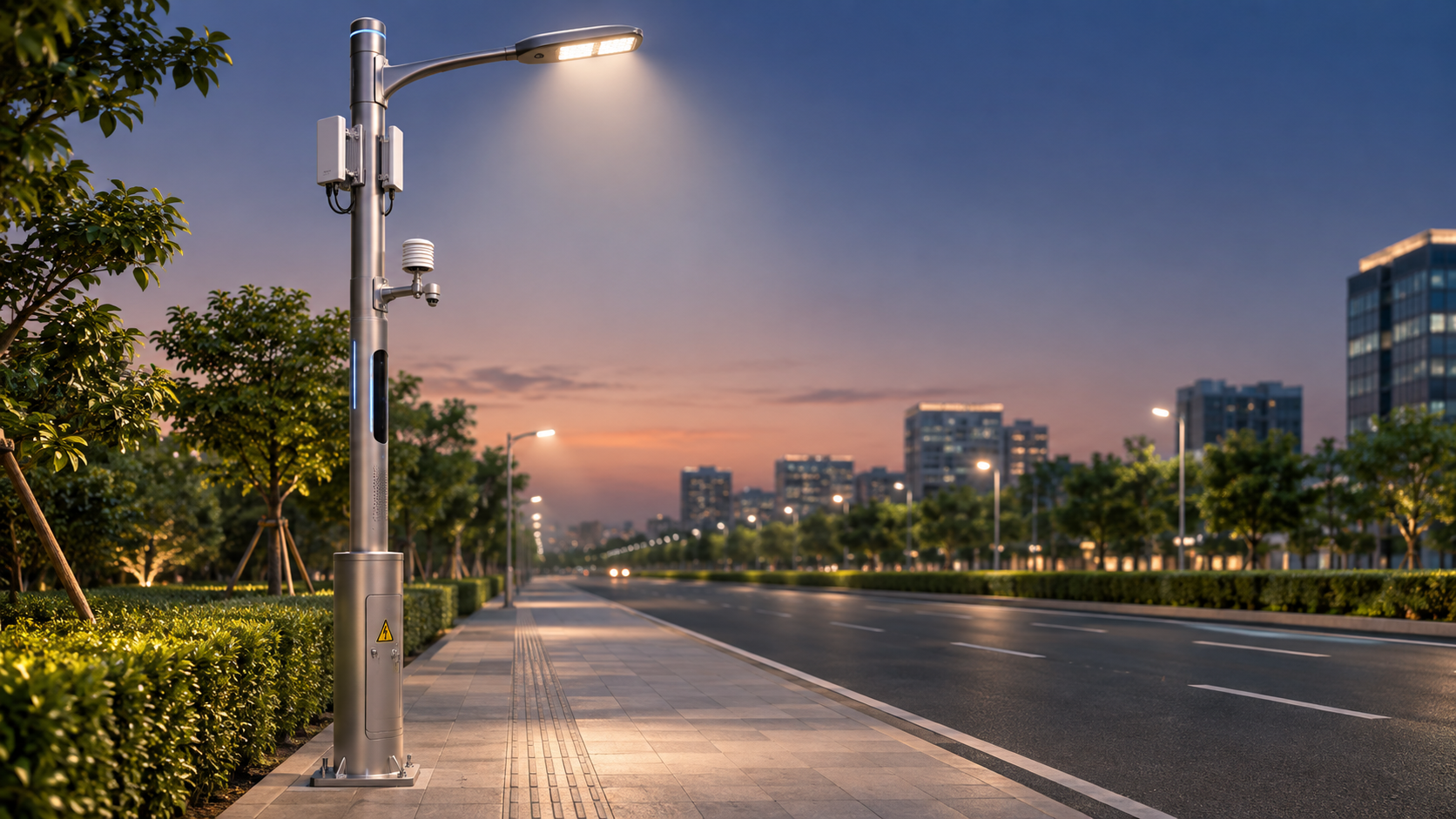
A smart utility pole brings lighting, connectivity, sensors, and other urban services together in a single roadside structure. For project owners and contractors, understanding how these poles work is essential to planning outdoor lighting and smart infrastructure projects. This guide explains the main functions of a smart utility pole and the site requirements that influence its installation, including power supply, network access, structural considerations, and maintenance.
What makes a utility pole “smart”?
A smart utility pole is an outdoor pole designed to support connected equipment as well as conventional services such as street lighting. Depending on the project, it may carry a luminaire, control gear, communications equipment, cameras, environmental sensors or a public information display.
The distinction is not simply the number of devices attached. A pole becomes useful as connected infrastructure when its equipment can exchange information or be managed through a control system. A streetlight with a remote dimming controller is one example; a pole with a camera but no network connection may still be useful, but it offers a different level of integration.
Not every location needs a fully equipped pole. On a quiet road, reliable lighting and remote fault reporting may be enough. In a busy public space, a project owner might also need communications equipment or sensors. Starting with the services the site actually needs helps avoid oversized structures and unnecessary maintenance.
What can a smart pole do?
Lighting is often the starting point. Connected controls can allow an operator to adjust lighting schedules, dim compatible luminaires or receive fault information. The available functions depend on the controller, luminaire and management platform; remote control should not be assumed just because a pole has a network connection.
Other equipment can use the same structure. Cameras may support site monitoring, while sensors can collect information about conditions such as air quality or traffic. Communications equipment can provide a link for pole-mounted devices and, where agreed with a network operator, support wider connectivity services. Displays or emergency communication devices may also be appropriate in some public areas.
Combining services can reduce the need for separate street furniture, but it also creates dependencies. A power fault, for example, may affect both the light and the communications equipment unless circuits and backup arrangements are designed accordingly. Camera placement and data handling can also raise privacy and operational questions that need to be settled before installation.
Lighting still needs its own design
A multifunction pole does not automatically provide good illumination. Mounting height, spacing, optics, glare and the surfaces being lit still determine whether the lighting works. A pole position chosen for network coverage may not be the best position for a pedestrian crossing or plaza.
For accent or area lighting, the fixture should be selected for the actual aiming distance and required beam. For example, Lishida’s TGD-031 LED Floodlight is offered with several beam angles and an IP66 protection rating. Such an option may suit plaza or landscape applications, but the beam, mounting arrangement and electrical configuration still need to be checked against the lighting design. An outdoor rating alone does not establish that a fixture is suitable for every exposed location.
Site requirements that shape installation
Power supply and electrical design
Check both the available supply and when it is energized. An existing streetlighting circuit may be switched off during the day, while a camera, communications device or sensor may need continuous power. Connecting all equipment to the lighting circuit without checking its operating schedule is a straightforward way to create an unreliable system.
The electrical design should account for the combined load, voltage compatibility, protective devices, grounding and surge protection. Separate circuits or metering may be needed where equipment has different operators or service requirements. Backup power, if required, should be sized for the devices that must remain operational—not assumed to cover the entire pole.
Network access and system compatibility
A pole can connect through fiber, a cellular network or another suitable communications method, depending on the site and equipment. Fiber may offer a dependable connection, but the route, access rights and civil works need to be understood. Cellular connectivity can avoid some cabling, although coverage should be checked at the proposed location rather than inferred from a general coverage map.
It is also worth asking who manages the connection and how devices will communicate with the chosen platform. Lighting controls, sensors and cameras may come from different suppliers. Confirm interfaces, remote access arrangements and responsibility for software updates before equipment is specified.
Structure, foundation and surroundings
Each attachment changes the demand on the pole. A display or antenna adds wind-exposed area as well as weight, and equipment mounted high on the shaft can have a different structural effect from equipment mounted lower down. The pole and foundation should therefore be assessed for the complete proposed configuration, including reasonable future additions.
Ground conditions, buried utilities, drainage, road clearance and local wind conditions all matter. An existing foundation should not be reused simply because it supported a conventional streetlight: its capacity and condition need to be verified. Local requirements, utility-owner permissions and any applicable road authority rules should be checked for the specific site.
Access for maintenance
A pole that looks compact on a drawing can be awkward to service beside live traffic or within a crowded pedestrian area. Allow space for safe access to the handhole, control equipment and mounted devices. Consider whether a maintenance vehicle can reach the pole and whether work on one device will interrupt other services.
Weather sealing and corrosion resistance should suit the exposure, while connectors and internal layouts should allow components to be replaced without dismantling the entire assembly. Documenting cable routes, device ownership and spare parts is equally practical: several organizations may have equipment on the same structure but different maintenance responsibilities.
Plan around the site, not just the pole
A useful early step is to list the services required now, identify who operates each one, and reserve capacity only for credible future needs. That gives the structural and electrical teams a clearer basis for design than a catalogue of every possible attachment.
Lishida Smart Lighting supports contractors and project owners with outdoor lighting products, smart controls and project-based solutions, drawing on its experience with large-scale projects across China. Whatever the supplier, the important next step is to bring lighting, civil, electrical and communications requirements together before the pole and foundation are finalized. Changes made after installation are usually harder to accommodate than decisions made while the site is still being designed.
◉ MESSAGE

Blog
- What Is a Smart Utility Pole? Functions and Site Requirements
- LED Infrastructure Lighting Retrofits: Costs Beyond the Fixture
- What Determines Battery Life in Solar Street Lighting Systems?
- Highway Lighting Design: Uniformity, Glare and Pole Spacing
- Public Sector Lighting Procurement: Comparing Lifetime Costs
- Planning a Smart Pole Project: From Site Survey to Commissioning
- LED Bridge Lighting Design: Balancing Visibility and Glare
Message