
LED Infrastructure Lighting Retrofits: Costs Beyond the Fixture
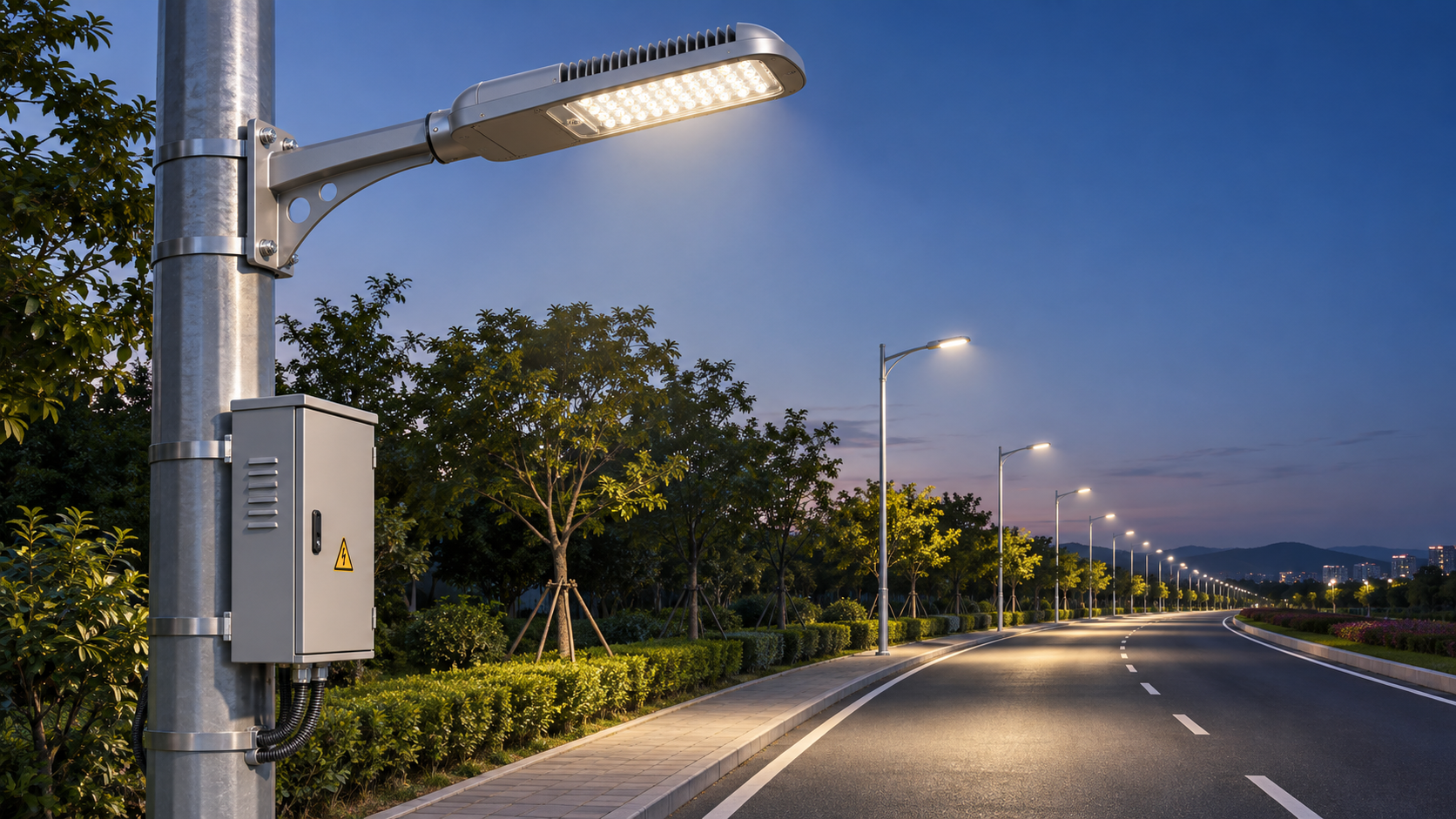
LED infrastructure lighting retrofits can reduce energy consumption and improve visibility, but the fixture price tells only part of the financial story. Installation, electrical upgrades, smart controls, traffic management and long-term maintenance all influence the final bill. For an owner planning improvements across roads, public spaces or dense urban areas, the most useful budget is not the one with the lowest unit price. It is the one that accounts for what must happen before, during and after installation.
Start with the assets, not the replacement count
A fixture schedule is a starting point, but it is not a complete scope of work. Two roads with the same number of luminaires can have very different retrofit costs if one has sound poles and accessible cabinets while the other has damaged brackets, uncertain wiring and restricted access.
Before requesting a firm price, check a representative sample of poles, foundations, mounting arms, cable entries, junction boxes and control cabinets. Look for corrosion, water ingress, damaged insulation and undocumented modifications. Where records are incomplete, bidders should identify their assumptions rather than quietly pricing different levels of risk.
A visual inspection alone may not reveal the condition of underground cables or foundations. For those items, agree on an inspection or testing approach and include an allowance for defects discovered after work begins. The alternative is a low initial bid followed by change orders that are difficult to compare or challenge.
Installation and access can outweigh the luminaire saving
A straightforward fixture swap from a service vehicle is one thing. Work above a busy road, near overhead utilities or in a crowded pedestrian area is another. Access equipment, lane closures, traffic control, permits and restricted working hours can materially change the cost per installation point.
Consider how the crew will move through the site. If each pole requires a separate closure or escort, a cheaper luminaire may have little effect on the overall budget. Conversely, coordinating lighting work with planned road maintenance may reduce duplicated mobilisation and disruption, provided the schedules are genuinely compatible.
Ask contractors to separate labour, equipment, traffic management and reinstatement in their pricing. That makes it easier to see whether a low bid assumes unrestricted daytime access while another includes night work and the necessary safety arrangements. Confirm who is responsible for permits, utility coordination and public notification; gaps between contracts can become delays rather than savings.
Electrical compatibility needs more than a voltage check
Lower connected load does not automatically mean an existing electrical system is ready for new equipment. Cabinet capacity, protective devices, earthing, cable condition and switching arrangements still need review. Driver characteristics and the number of luminaires on a circuit can also affect protection and switching equipment selection.
For example, replacing conventional streetlights with LED luminaires may change the starting current seen by a circuit. The contractor and equipment suppliers should check the proposed driver and protection-device combination rather than assuming that lower operating wattage resolves every electrical issue. Surge exposure is another site-specific consideration, especially where outages would be costly to investigate or repair.
The right procurement question is not simply, “Can we reuse the circuit?” It is, “What evidence supports reuse, and who pays if testing shows otherwise?” Include cabinet modifications, cable repairs and any required electrical verification as identifiable cost items.
Treat controls as an operating system, not an accessory
Dimming schedules, remote monitoring and fault alerts can make a retrofit more useful, but their value depends on what the owner can actually operate and maintain. A controller price may exclude commissioning, communications coverage, software access, integration, training or recurring service charges.
For a small public space, a simple programmed schedule may be sufficient. A road network with dispersed assets may justify remote fault visibility, especially when locating failures requires a separate inspection trip. Neither approach is automatically cheaper: compare the expected use of the data with the cost of collecting and managing it.
Before approving a connected system, establish who owns the operating data, how failed controllers are replaced, what happens if communications are lost and whether other suppliers’ equipment can be integrated. Request a demonstration of the proposed functions and a written breakdown of recurring costs. A feature that appears on a specification sheet but cannot be commissioned within the project scope is not yet a working feature.
Architectural lighting introduces a different set of costs
Public-realm projects often combine functional road lighting with façade or landscape lighting. These should not be priced as interchangeable applications. Architectural installations may require concealed wiring, custom brackets, careful aiming, access to building surfaces and coordination with the property owner.
For instance, the XQD-017 LED Wall Washer is listed at 36 W with IP66 protection and is intended for façades and landscapes. Its available beam angles and RGB or RGBW options are useful points to assess against the design, but a color-changing installation also requires the control, wiring and commissioning scope to be defined. Confirm the selected voltage and control configuration before comparing quotations. The fixture’s protection rating does not remove the need to detail connectors, cable routes and mounting for the actual exposure conditions.
Compare bids over an agreed operating period
A meaningful cost comparison includes the initial project price and the expected costs of operating it over the same period. Energy is one component: estimate annual consumption from the installed system wattage, expected operating hours and local electricity tariff. If dimming is proposed, use the intended schedule rather than applying an assumed saving without an operating plan.
Then consider cleaning, inspections, fault response, replacement drivers or control devices, software charges and the cost of accessing each location. A luminaire’s stated service life is not a guarantee that every component will operate without intervention for that period. Review warranty duration, exclusions, claim procedures and whether removal, transport and reinstallation labour are covered.
Spare parts deserve attention too. Ask how long compatible drivers, optical components and controllers are expected to remain available, and whether the owner can obtain configuration files and maintenance instructions. For a dispersed road network, a slightly higher purchase price may be easier to justify when replacement procedures and parts supply are clear.
Make uncertainty visible before awarding the contract
Issue bidders a common asset list, lighting requirements, access assumptions and proposed work windows. Require them to identify exclusions and price foreseeable variations, such as replacing a damaged bracket or repairing a cable section. Where a site survey cannot resolve every unknown, agree on how quantities will be measured and approved.
Delivery responsibility matters as much as the equipment list. Lishida Smart Lighting supports contractors and owners with outdoor lighting products, controls and project-based solutions, drawing on experience with large-scale projects in China. On a retrofit, that kind of coordination is most useful when the product, electrical and control interfaces are reviewed together—not left for the installation crew to resolve on site.
Before signing, select a representative section for a trial installation if access and schedule allow. Use it to check mounting, light distribution, control operation and the time needed for the work. Record the findings and update the remaining scope. That small step can expose an assumption that would otherwise be repeated across the whole network.
◉ MESSAGE

Blog
- What Is a Smart Utility Pole? Functions and Site Requirements
- LED Infrastructure Lighting Retrofits: Costs Beyond the Fixture
- What Determines Battery Life in Solar Street Lighting Systems?
- Highway Lighting Design: Uniformity, Glare and Pole Spacing
- Public Sector Lighting Procurement: Comparing Lifetime Costs
- Planning a Smart Pole Project: From Site Survey to Commissioning
- LED Bridge Lighting Design: Balancing Visibility and Glare
Message