
Public Sector Lighting Procurement: Comparing Lifetime Costs
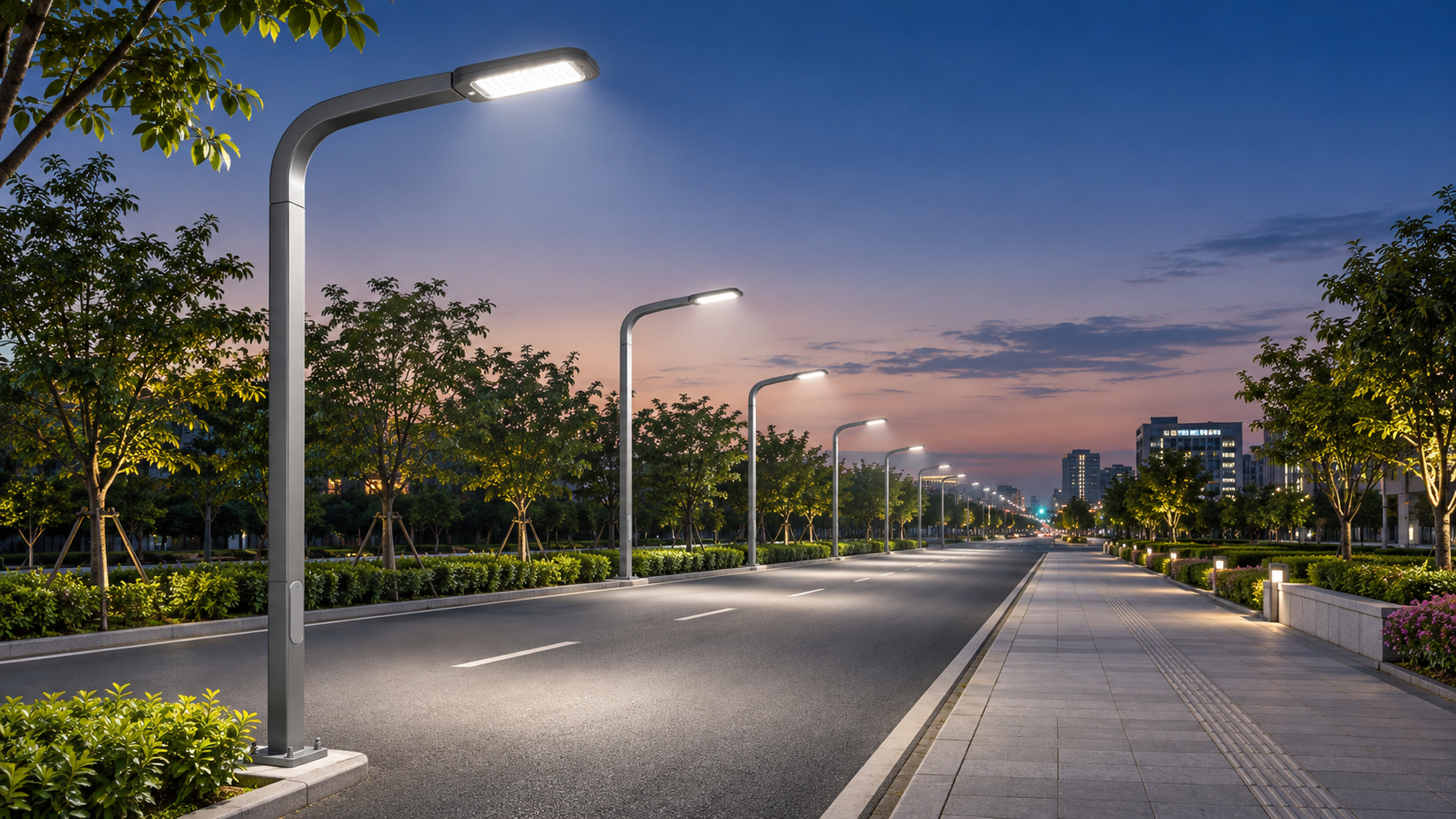
In public sector lighting procurement, the lowest upfront price does not always deliver the best long-term value. Procurement teams must weigh energy consumption, maintenance requirements, replacement cycles, and smart control compatibility against initial purchase and installation costs.
For roads, public spaces, and other outdoor environments, comparing these lifetime costs helps decision-makers build more realistic budgets and select solutions suited to project needs. This guide explores the key factors to consider when evaluating outdoor lighting options and their impact on total expenditure.
What Should a Lifetime Cost Comparison Include?
A useful comparison accounts for every significant expense the authority expects to incur over a defined period, as well as any credible residual value.
Include purchase, installation, electricity, inspections, repairs, component replacements, control software, communications, and end-of-life disposal. Where applicable, include financing costs and the value of recoverable equipment.
Separate costs borne by the authority from those covered by a contractor or utility. A maintenance-inclusive contract may reduce internal spending while increasing service fees.
Use the same evaluation period, lighting requirements, operating hours, and financial assumptions for every bid. Otherwise, a lower total may reflect different assumptions rather than better value.
For projects with costs spread across many years, calculate net present value using the discount rate required by the authority. Record the rate and explain any exceptions.
How Can Procurement Teams Compare Bids Fairly?
Begin with a common specification for the area to be lit, including applicable lighting standards, required service levels, environmental conditions, and installation constraints.
Ask bidders to submit a completed cost schedule alongside technical documentation. Require them to identify exclusions, assumptions, replacement intervals, warranty terms, and optional services separately.
Request lighting calculations and performance data for the proposed configuration. A cheaper luminaire is not comparable if more units or taller poles are needed to meet requirements.
Check whether quoted power covers the complete system, including drivers and controls. For solar systems, request a separate energy balance and battery replacement forecast.
Apply the published evaluation method consistently, including any quality and technical criteria permitted by the relevant procurement rules. Keep calculations and clarification responses for the audit record.
How Much Will Energy Cost Over the Evaluation Period?
For grid-connected lighting, estimate annual consumption using total system power, the number of luminaires, and annual operating hours. Convert watt-hours to kilowatt-hours before applying the tariff.
For example, 100 luminaires drawing 100 watts each for 4,000 hours consume 40,000 kWh annually. At $0.12 per kWh, annual electricity costs are $4,800.
If an alternative draws 60 watts per luminaire under the same conditions, annual consumption falls to 24,000 kWh, costing $2,880 at the same tariff.
The illustrative annual saving is $1,920 before maintenance, tariff changes, controls, and discounting. Both designs must still deliver the same required lighting performance.
Model expected tariff changes where policy permits, and test a higher-price scenario. Include fixed supply charges or metering costs when they differ materially between options.
Dimming and adaptive controls can reduce consumption further, but savings depend on approved schedules and actual use. Avoid counting theoretical savings without evidence or operational agreement.
Which Maintenance and Replacement Costs Matter Most?
Outdoor lighting maintenance involves more than replacement parts. Access equipment, traffic management, technician travel, fault diagnosis, and administrative processing can exceed the component price.
Ask suppliers for expected failure rates, maintenance procedures, spare-part availability, and repair times. Distinguish between a luminaire's rated life and the life of individual components.
Drivers, control nodes, batteries, and surge protection devices may need replacement before the pole or luminaire. Schedule these costs explicitly rather than assuming one system-wide lifespan.
Consider the site's access conditions. A fault on a busy road may require lane closures, while a remote park can involve longer travel and limited vehicle access.
Review warranty exclusions and remedies carefully. A replacement component supplied free of charge may still leave the authority responsible for removal, installation, and traffic management.
Estimate residual value conservatively and deduct disposal costs where relevant. Require evidence for material recovery assumptions, especially when batteries or electronic equipment need specialist handling.
When Can Solar Lighting Reduce Total Project Costs?
Off-grid solar lighting deserves consideration where grid connections require long cable runs, road crossings, trenching, or network upgrades. Avoided infrastructure can materially change the comparison.
Assess solar alternatives against local sunlight, shading, seasonal demand, and required lighting hours. A low initial quotation is insufficient without a site-specific energy and autonomy calculation.
For example, Solar Street Lighting | SL-004 is presented as an off-grid option that avoids wiring and trenching.
Its listed configuration includes a six-metre pole, 30–100 W power options, IP65 protection, and a LiFePO4 battery with a stated lifespan exceeding eight years.
Those figures are supplier specifications, not a guarantee of project performance. Request a configuration-specific design, local solar assessment, battery warranty, and replacement cost before evaluation.
The supplier cites potential total project savings of up to 70%, but actual savings depend on the baseline and site conditions. Do not apply that figure without supporting calculations.
Solar also introduces battery replacement, panel cleaning, and performance risks during prolonged poor weather. Compare those costs with grid connection, electricity, and maintenance on equivalent service terms.
Are Smart Controls Worth the Additional Cost?
Smart controls may support dimming, fault reporting, and operating schedules, potentially reducing energy use and unnecessary inspection trips. Their value depends on the authority's operating model.
Include nodes, gateways, installation, commissioning, connectivity, software licences, cybersecurity updates, and ongoing support. Confirm whether charges rise with the number of connected assets.
Ask how the system integrates with existing asset management platforms and whether data can be exported in usable formats. Clarify ownership of operational data and configuration settings.
Check interoperability claims against named standards and actual compatible products. Establish what continues to work if a communications provider, software service, or equipment supplier changes.
Where projected savings rely on fewer callouts, identify the current inspection and repair costs first. Then test whether staffing arrangements allow those savings to be realised.
How Should Teams Handle Uncertainty and Make a Decision?
Present a base case for each compliant bid, then test the assumptions most likely to change the ranking. Energy prices, failure rates, installation costs, and battery life are common variables.
For each scenario, document the source of the assumption and who bears the risk. A fixed-price maintenance commitment may shift some uncertainty, subject to contract terms.
Consider affordability as well as total value. A lower lifetime cost may require a higher capital budget, while recurring licence fees create future operating commitments.
Use the results to identify questions for bidders, not to manufacture precision. Where two options are close, delivery capability, warranty enforceability, and performance risk may matter.
Conclusion: Choose the Best Evidenced Lifetime Value
Strong public sector lighting procurement compares compliant solutions over the same period, using transparent assumptions for installation, energy, maintenance, replacements, controls, and disposal.
The best choice is the option that meets required service levels at an acceptable whole-life cost and risk, with commitments that can be monitored throughout the contract.
◉ MESSAGE

Blog
- Public Sector Lighting Procurement: Comparing Lifetime Costs
- Planning a Smart Pole Project: From Site Survey to Commissioning
- LED Bridge Lighting Design: Balancing Visibility and Glare
- Energy-Saving Modes for LED Urban Furniture Lighting Explained
- How to avoid vendor lock-in in a government smart lighting project
- Sizing the communications power budget for smart city solar street lights
- How energy-saving mode affects solar bollard light operating time
Message