
Energy-Saving Modes for LED Urban Furniture Lighting Explained
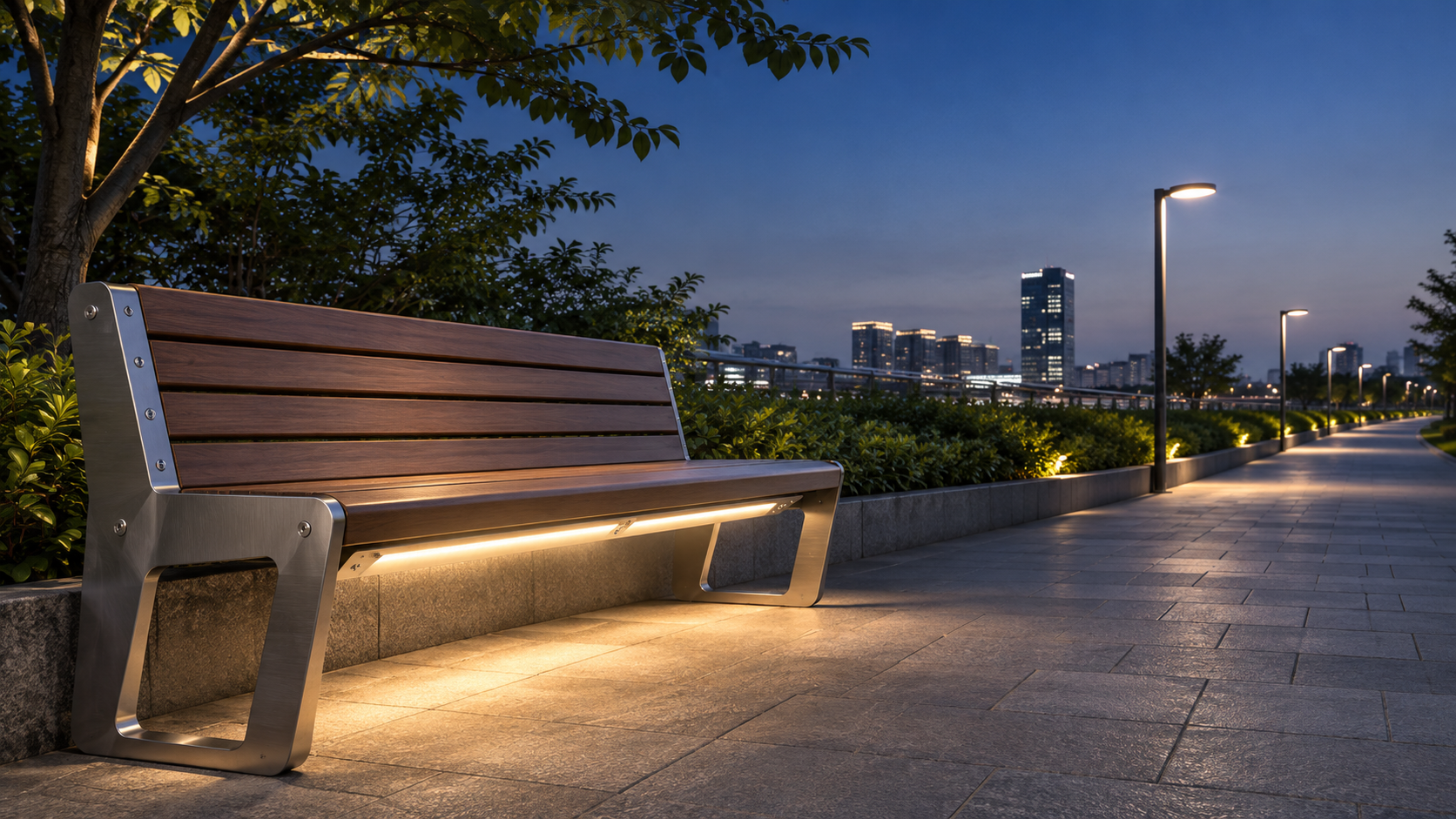
LED urban furniture lighting with energy-saving mode reduces electrical demand by changing light output in response to a schedule, detected activity, ambient light, or a combination of these inputs. The technical question is whether the reduced setting still delivers the required illumination where and when it is needed. A dimming percentage alone cannot establish that: the result also depends on the luminaire’s light distribution, mounting position, driver behavior, and the lighting already present around the furniture.
Illuminated benches, shelters, bollards, and other public-space furniture often serve both orientation and amenity functions. A setting that keeps a seat visible may leave the adjacent walking surface too dark, while a brighter surrounding streetlight may make the furniture’s own light less necessary. Energy-saving modes should therefore be assessed against the complete nighttime scene rather than the fixture in isolation.
Scheduled dimming and its limits
A scheduled mode reduces output during preset periods, such as late at night, and restores it before activity increases. Schedules can be stored locally in a driver or issued through a central control system. Local scheduling avoids dependence on a continuous network connection, but changing a large installation’s timetable can be labor-intensive unless remote configuration is available.
A fixed clock schedule works best where use follows a reasonably predictable pattern. Seasonal changes, events, and transport disruptions can shift activity outside the expected hours. Astronomical scheduling can adjust switching times relative to sunrise and sunset, but it does not measure actual pedestrian activity or account for local shading. Where a controller uses clock time, its time source, daylight-saving behavior, and response to power loss should be established before commissioning.
Define dimming levels in terms of the intended lighting outcome as well as the control command. A command of 50% does not necessarily produce 50% of rated electrical power, and a driver’s control percentage does not always correspond directly to measured illuminance. Driver losses, dimming curves, and minimum stable output affect the result. Measurement at the relevant surfaces is more useful than assuming a linear relationship.
Occupancy control: detection is part of the lighting design
Occupancy-based lighting holds a reduced background level and increases output when a sensor detects movement or presence. It is useful where activity is intermittent, but the detection zone must extend far enough beyond the illuminated area for the light to respond before a person reaches it. At a shelter, for example, mounting the sensor behind a panel or inside a metal enclosure can obstruct coverage along the approach.
Passive infrared sensors respond to changes in infrared radiation and are affected by the direction of movement, temperature contrast, and obstructions. Microwave or other radio-frequency sensors have different coverage characteristics and can detect movement beyond the intended area. Sensor choice should follow the geometry of the site, not simply the nominal detection range on a datasheet.
Three settings determine much of the operating behavior:
- Background level: A low standby output saves energy, but the route and furniture still need to remain legible when no motion is detected.
- Hold time: If it is too short, the light can drop while someone is seated or moving very little. A long hold time reduces switching but also reduces the expected saving.
- Transition time: Gradual dimming can make changes less distracting; the increase to the active level must still occur soon enough for the approach.
Motion detection and presence detection should not be treated as interchangeable terms. Confirm whether the selected sensor can reliably maintain the active state for the expected patterns of movement, including a person waiting quietly at a stop. Site testing should cover approaches from different directions, parked objects, vegetation, and nearby traffic that could trigger unwanted operation.
Adaptive modes and control priority
Adaptive lighting combines inputs or rules to select an output. A furniture luminaire might follow a nighttime schedule, rise to an active level on detection, and remain off during daylight. In a networked installation, a central system can also change operating profiles for an event or maintenance period.
The interaction between commands needs to be explicit. If a schedule calls for a low level while a sensor requests full output, the control logic must define which request takes priority and when the luminaire returns to its scheduled state. The same applies to manual overrides and emergency instructions from an external system. Without an agreed priority order, individually functional components can produce an inconsistent site response.
Daylight sensing also requires careful placement. A sensor exposed to a luminaire’s own output, reflections from a shelter roof, or light from passing vehicles can produce unstable switching. Separate switch-on and switch-off thresholds, where supported, and an appropriate delay help prevent repeated changes around the threshold. A photocell that merely switches at dusk and dawn should not be confused with continuous daylight dimming.
Comparing energy performance
Estimate energy use from input power at each operating state multiplied by the hours spent in that state. Add the consumption of sensors, communications equipment, and controllers that remain energized. For occupancy control, the assumed number and duration of activations are often more influential than the advertised dimming level.
For example, a luminaire with a low standby setting may consume less during an empty period, yet frequent detections or a long hold time can keep it near its active output for much of the night. Conversely, a fixed schedule provides a repeatable estimate but may dim during an unexpectedly busy period. Compare alternatives using the same operating hours, lighting criteria, and representative activity profile; otherwise, the apparent saving may come from different assumptions about service.
For off-grid installations, energy management is also tied to the battery budget. The linked Solar Street Lighting | SL-004 is specified for off-grid lighting with a 30–100 W power range and a LiFePO4 battery option. Its stated module conversion efficiency and MPPT efficiency describe different parts of the charging chain; neither establishes the energy available to the luminaire on a particular night. Confirm the configured panel and battery capacities, local solar conditions, load profile, and required operating autonomy. Energy-saving controls and their compatibility with the selected configuration should be verified separately.
Maintained lighting, integration, and commissioning
The lowest permitted operating level should be evaluated against the applicable project lighting criteria, including the area to be illuminated, uniformity, glare, and any security or accessibility requirements. The relevant standard and its edition depend on the location and application. Initial measurements alone do not represent the full service period: dirt, component aging, and obstructions can reduce delivered light, so the design must account for maintained performance.
Integration details matter when drivers, sensors, and control systems come from different sources. Confirm the supported control interface, dimming range, addressing method, and whether the specified driver can dim smoothly at the intended minimum. A shared interface name does not by itself prove that every command, feedback value, or fault indication is supported across devices.
Before handover, test the installed system at night in each specified mode. Record input power and illuminance at agreed locations, then trigger the sensor from the actual approaches and observe the hold and fade periods. Repeat the relevant tests after a controller restart and, where networked, during a communications interruption. The documented fallback state should preserve the project’s required lighting behavior until normal control is restored.
◉ MESSAGE

Blog
- LED Bridge Lighting Design: Balancing Visibility and Glare
- Energy-Saving Modes for LED Urban Furniture Lighting Explained
- How to avoid vendor lock-in in a government smart lighting project
- Sizing the communications power budget for smart city solar street lights
- How energy-saving mode affects solar bollard light operating time
- Comparing lead times from LED street light luminaire suppliers in Europe
- What spare parts support should a smart street light exporter offer?
Message