
LED Pedestrian Lighting for Subway Stations: Glare Control and Safety Design Basics
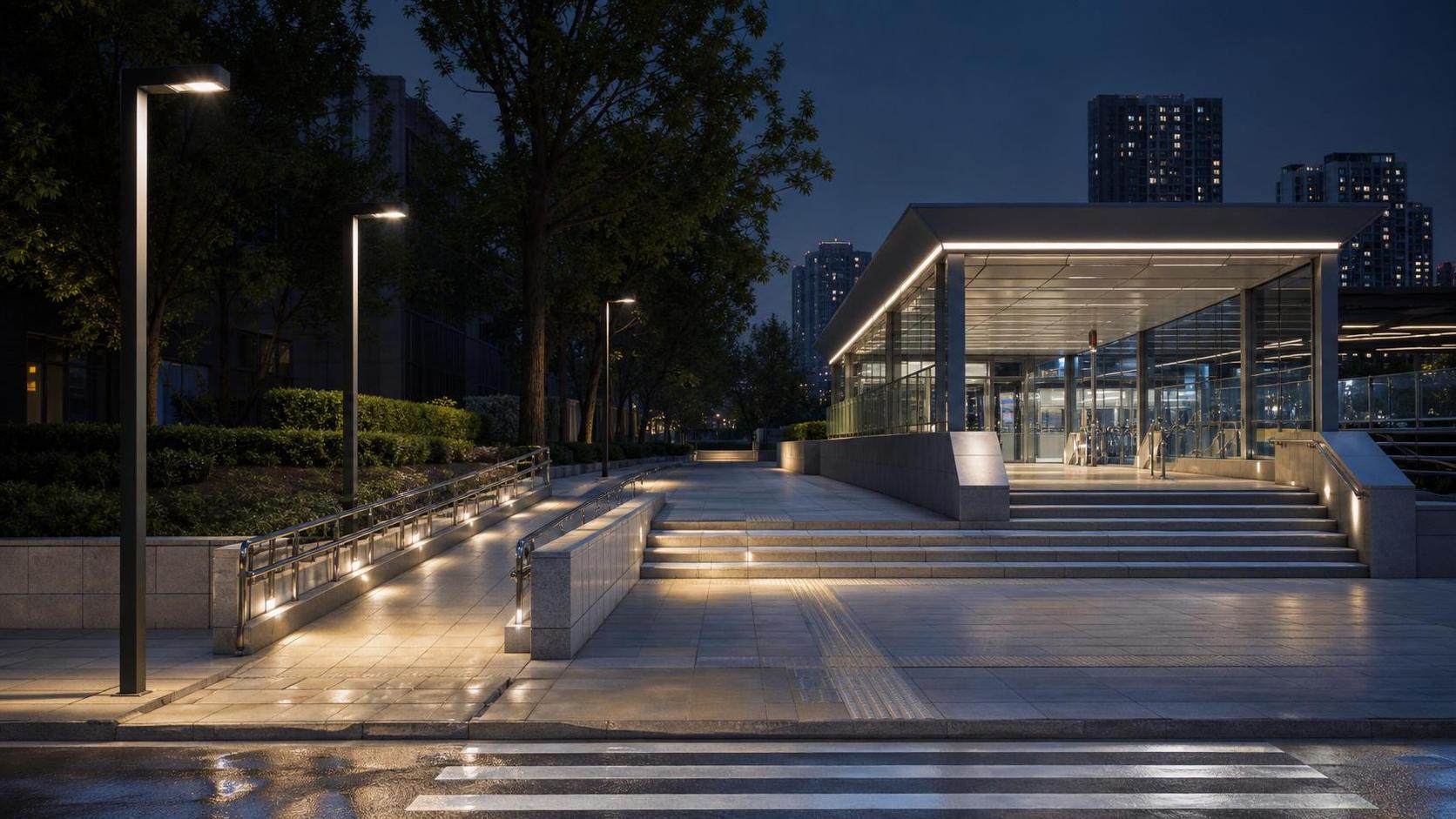
LED pedestrian lighting for subway stations is not only about brightness. It is about controlling glare, guiding movement, revealing hazards early, and keeping visual conditions stable in crowded, high-pressure transit spaces.
In practice, poor lighting can create sharp contrast, hidden edges, and visual fatigue. That is why glare control and safety design have become central issues in outdoor lighting plans connected to station entrances, plazas, ramps, crossings, and transfer pathways.
For projects with complex delivery requirements, lighting decisions also affect maintenance cycles, system integration, and long-term operating risk. This is especially relevant in large urban developments where public safety expectations are high and performance gaps are quickly exposed.
Why subway pedestrian lighting needs a different approach
Subway environments are visually demanding. Passengers move between daylight, shaded canopies, reflective surfaces, vehicle lights, and underground entrances within a short distance.
That transition makes ordinary outdoor lighting rules insufficient. LED pedestrian lighting for subway stations must support safe adaptation, not just meet a target lux value.
The most common failures are familiar: over-bright fixtures near eye level, dark patches between poles, wet pavement reflections, and inconsistent color appearance across the site.
When these issues combine, people slow down, hesitate at crossings, or miss steps and curb edges. In busy stations, small visibility problems can quickly become safety problems.
What glare control really means on site
Glare is often misunderstood as simple over-illumination. More accurately, it is excessive brightness in the wrong place, at the wrong angle, or against the wrong background.
For LED pedestrian lighting for subway stations, glare control depends on optics, mounting height, luminaire tilt, shielding, and the reflectance of surrounding materials.
Key glare sources around stations
- Low-mounted fixtures that expose the light source directly to approaching pedestrians
- Highly polished stone or wet concrete that throws light back into the eye
- Entrances with strong contrast between exterior lighting and interior darkness
- Mixed fixtures with different beam patterns and color temperatures
A safer design usually favors controlled distribution, lower visual harshness, and more even luminance across walking surfaces. This helps people read space faster and move with fewer visual interruptions.
The safety basics that matter most
In operational terms, LED pedestrian lighting for subway stations should help users identify direction, surface condition, level changes, obstacles, and conflict points without hesitation.
Uniformity matters because isolated bright zones can hide darker risks nearby. Color temperature matters because overly cold light may increase visual discomfort in reflective settings, while warm light that is too dim may reduce clarity.
Placement also matters. Fixtures should support crossings, ticket hall approaches, drop-off edges, bicycle connections, stair landings, and accessible routes as one connected visual system.
From product choice to long-term control
Lighting quality is shaped by more than the luminaire itself. The project outcome depends on how products, controls, structure, and maintenance strategy work together.
This is where integrated project support becomes useful. In large-scale urban work, Lishida Smart Lighting combines lighting products, smart control systems, and project-based coordination for demanding outdoor environments.
That experience matters because station-adjacent lighting often shares constraints with roads, public spaces, and mixed circulation zones. Product selection must account for execution realities, not just catalog performance.
For example, a fixture family such as Modern Street Lighting|MSL-XM reflects the kind of durability metrics many public projects look for, including IP67 protection, luminous efficacy of at least 140 lm/W, and service life above 50,000 hours.
Those specifications do not automatically make it a subway solution. Still, they show the baseline thinking needed for exposed pedestrian zones connected to transit infrastructure, where weather resistance and stable output directly affect safety consistency.
Practical checks during review and acceptance
Drawings and photometric files are only the starting point. On-site review should confirm that the installed system matches the intended visual effect under real operating conditions.
Points worth checking in the field
- Direct view of LED sources from approach paths and crossing lines
- Brightness difference between entrance zones and adjacent walkways
- Shadowing at bollards, railings, signage, and planter edges
- Performance after rain, when reflective glare often becomes more severe
- Control logic for dimming, scheduling, and fault response
It is also useful to review materials and support structures. In exposed urban sites, galvanized and powder-coated steel, adequate pole thickness, and secure base plate installation can influence long-term alignment and reliability.
Where to focus next
A strong lighting plan for transit access areas begins with the pedestrian journey, not the fixture schedule. Map how people approach, pause, cross, descend, and exit, then test whether the lighting supports each moment clearly.
When evaluating LED pedestrian lighting for subway stations, compare optics, glare shielding, uniformity, ingress protection, control compatibility, and maintenance access together. Looking at only wattage or pole spacing usually misses the real risk points.
The next practical step is to build a review checklist around visibility, glare, durability, and system coordination. That creates a more reliable basis for judging designs, approving products, and keeping station-adjacent spaces safer over time.
◉ MESSAGE
Blog
- LED Street Luminaire Specifications That Matter for Roadway Projects
- What to Evaluate When Selecting a Smart Street Lamp Manufacturer
- How to Prepare a Compliant Solar Lighting Bid for Public Infrastructure Projects
- LED Street Lighting Solutions for Urban and Municipal Roads
- LED Street Light Installation Guide for Road Projects
- LED Street Light Lifespan: How Long Do LED Road Lights Last?
- LED Street Light IP Rating: What Should Buyers Choose?
Message